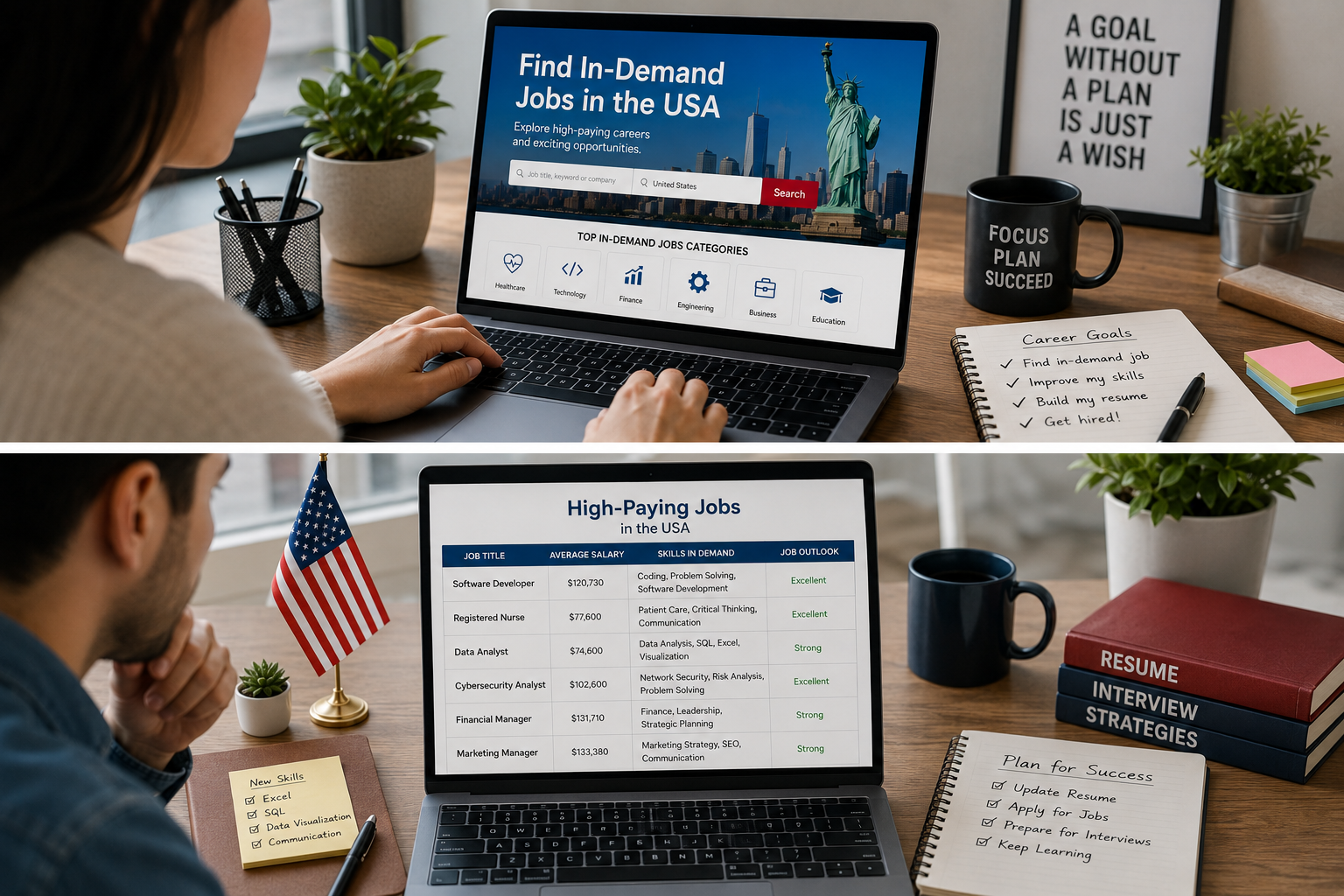
If you’ve been scrolling through job boards lately or talking with friends about career moves, you’ve probably noticed something interesting. The conversation isn’t just about “finding any job” anymore. People are asking sharper questions: Which roles will still be hiring a few years from now? Which ones pay well enough to build a real life around? And which skills actually move the needle?
I remember sitting with a cousin last year who felt stuck after a decade in retail management. She wasn’t looking for a dramatic reinvention—just a clearer path with better pay and more stability. When we looked at the data together, the picture that emerged was surprisingly hopeful. Certain fields are expanding fast, salaries in many of them sit well above the national median, and the doors into those careers are more varied than they used to be.
Here’s a practical, grounded look at the top in-demand jobs in the USA, based on the latest projections from the U.S. Bureau of Labor Statistics and broader labor market trends. I’ll cover projected growth, typical pay, the skills employers keep mentioning, and realistic ways people are breaking into these roles.
The Bigger Picture: Why These Jobs Are Rising
A few forces are shaping the job market more than others. An aging population continues to drive healthcare demand. Businesses of every size are still racing to adopt artificial intelligence, secure their data, and modernize operations. The push toward cleaner energy is creating real openings in installation and maintenance roles. And across almost every industry, companies need people who can manage complexity—whether that’s a hospital system, a software team, or a construction project.
The overall economy is projected to grow modestly, but certain occupations are expected to expand far faster than average. Healthcare support and practitioner roles, computer and mathematical occupations, and selected skilled trades stand out. Absolute job numbers matter too: some roles may not post the highest percentage growth but will still add tens or hundreds of thousands of positions.
Salaries vary widely by location, experience, and employer. The figures below use recent national median annual wages (around 2025 data) as a reference point. Coastal tech hubs and high-cost cities often pay more; rural areas and smaller metros usually pay less. Benefits, overtime, and bonuses can also shift the real picture.
Healthcare Roles Leading the Pack
Healthcare remains one of the most reliable sources of job growth. An older population, chronic health conditions, and ongoing provider shortages mean these positions aren’t going away anytime soon.
Nurse Practitioners sit near the top of nearly every “fastest-growing” list. Employment is projected to grow around 41 percent over the coming decade—dramatically faster than the average for all occupations. Median pay hovers around $132,000. Nurse practitioners examine patients, diagnose conditions, order tests, and in many states prescribe medication, often with a high degree of independence. Most need a master’s degree (sometimes a doctorate) and national certification. Registered nurses frequently move into this role after gaining clinical experience. The combination of strong pay, autonomy, and meaningful patient impact makes it attractive for people who want both financial stability and purpose.
Physician Assistants also show strong projected growth (around 21 percent) with median pay near $136,000. They work under physician supervision but handle a wide range of clinical tasks. A master’s-level PA program is the typical entry route. Demand remains high in primary care, surgery, and specialty clinics.
Medical and Health Services Managers (often called healthcare administrators or hospital managers) are projected to grow about 24 percent, with median pay around $124,000. These professionals keep facilities running—budgeting, staffing, compliance, quality improvement. A bachelor’s degree is common; many hold master’s degrees in health administration or related fields. Experience in clinical or administrative roles helps a lot.
Other healthcare support roles are also expanding quickly. Physical therapist assistants, occupational therapy assistants, psychiatric technicians, and home health and personal care aides all show solid growth. Pay ranges more widely here—from the mid-$30,000s for many aide positions to the upper $60,000s or higher for therapy assistants. These roles often require shorter training (certificates or associate degrees) and offer faster entry points.
Mental health counseling roles are growing as awareness and need increase. Substance abuse, behavioral disorder, and mental health counselors are projected for roughly 18 percent growth, with median pay around $59,000. Many positions require a master’s degree and licensure.
Technology and Data Roles
Technology continues to reshape almost every industry, which keeps demand high for people who can build, secure, and interpret systems.

Data Scientists rank among the fastest-growing occupations, with projected growth around 35 percent and median pay near $120,000. They collect, clean, and analyze large datasets to help organizations make decisions. Strong skills in statistics, programming (especially Python and R), machine learning, and data visualization are essential. Many hold bachelor’s or master’s degrees in quantitative fields. Entry can also come through bootcamps, self-directed projects, and demonstrated portfolios.
Information Security Analysts (cybersecurity roles) are projected to grow about 21 percent, with median pay around $129,000. As cyber threats grow more sophisticated, organizations need people who can protect networks, investigate breaches, and design security policies. Relevant certifications (CompTIA Security+, CISSP, and others), hands-on experience, and continuous learning matter as much as formal degrees for many employers.
Software Developers may not always top the “fastest percentage growth” lists, but they still add large numbers of jobs and command strong pay (median around $136,000). Demand remains solid for people who can build applications, integrate AI tools, and maintain systems. Cloud skills, modern programming languages, and the ability to work with AI-assisted development tools are increasingly valuable.
Computer and Information Research Scientists and related advanced roles show strong growth and higher pay (median around $140,000), though they typically require advanced degrees. Computer and information systems managers also sit high on both growth and compensation lists (median near $175,000).
AI and machine learning engineering roles continue to appear frequently in industry hiring data, often with very competitive compensation, especially at mid-to-senior levels. These positions usually demand strong programming, model-building experience, and the ability to apply AI to real business problems.
Green Energy and Skilled Trades
Not every high-demand job requires a four-year degree. The energy transition and ongoing infrastructure needs are creating openings in the trades.
Solar Photovoltaic Installers are among the fastest-growing occupations by percentage (around 37 percent), though the absolute number of jobs is smaller. Median pay is around $53,000. Wind turbine service technicians show roughly 30 percent projected growth with median pay near $64,000. Both roles typically require technical training or apprenticeships rather than long university degrees. Physical fitness, comfort with heights (for wind), and electrical knowledge help.
Industrial machinery mechanics and related maintenance roles are also growing as manufacturing and automation expand. Electricians, HVAC technicians, and construction-related supervisors remain in steady demand, with pay that can reach solid middle-class levels and, for experienced workers, considerably higher. Many of these paths run through apprenticeships, trade schools, or community college programs.
Other Notable Opportunities
Logisticians and supply-chain-focused roles continue to benefit from complex global and domestic distribution needs. Median pay sits in the low-to-mid $80,000s with solid growth.
Management roles across industries—general and operations managers, financial managers, project management specialists—keep appearing in high-demand lists because organizations still need people who can coordinate work, manage budgets, and lead teams. Pay varies but frequently exceeds $100,000 for experienced professionals.
Skills That Keep Showing Up
Across these different fields, certain capabilities appear again and again in job postings and employer surveys.
Technical skills that stand out include:
- Data analysis and basic statistical thinking
- Familiarity with AI tools and the ability to work alongside them
- Cybersecurity awareness (even for non-security roles)
- Cloud platforms and modern software tools
- Domain-specific technical knowledge (clinical skills in healthcare, electrical knowledge in energy and trades)
Human and adaptive skills matter just as much:
- Clear communication with both technical and non-technical people
- Problem-solving and critical thinking
- Adaptability and continuous learning
- Collaboration and the ability to work across teams
- Attention to detail, especially in regulated fields like healthcare and security
Employers repeatedly say they struggle to find people who combine solid technical ability with the soft skills needed to apply it in real workplaces. People who can explain complex ideas simply, handle changing priorities, and work well with others often have an edge.
How People Are Actually Getting Into These Roles
There is no single path. Some of the strongest routes include:
- Traditional degrees (especially for nurse practitioners, physician assistants, many data and research roles)
- Community college certificates and associate degrees (therapy assistants, many technical roles)
- Apprenticeships and trade programs (solar, wind, electricians, mechanics)
- Bootcamps, online certifications, and self-directed portfolios (data, cybersecurity, software)
- Internal transitions—registered nurses moving into nurse practitioner programs, IT staff adding security certifications, operations people moving into logistics or management
Geographic flexibility helps. Some high-paying roles concentrate in certain metros, while healthcare and trades openings exist more widely. Remote and hybrid options remain available in many tech and data positions, though not all.
Salary progression usually improves with experience, specialization, and additional credentials. Location, employer type (hospital system vs. private practice, large tech firm vs. smaller company), and negotiation also play big roles.

Practical Advice If You’re Planning a Move
Start by getting honest about your current skills, interests, and constraints (time, money, family responsibilities). Look at actual job postings in the fields that interest you and note the repeated requirements. Then close the gaps methodically—whether that means a formal program, targeted certificates, or building a portfolio of real work.
Talk to people already doing the job. Informational conversations remain one of the most useful ways to understand day-to-day reality versus the polished description. Many professional associations and local workforce boards also offer guidance and sometimes funding support for training.
Stay flexible. The specific tools and technologies will keep evolving. The underlying need for people who can deliver healthcare, secure systems, analyze information, install and maintain energy infrastructure, and coordinate complex work is likely to remain.
Final Thoughts
The job market is not uniformly easy, but it does contain clear pockets of strong demand and solid pay. Healthcare roles, data and security positions, selected technology careers, and skilled trades related to energy and infrastructure stand out. Many of these paths offer both financial opportunity and the chance to do work that feels meaningful.
No single list captures every possibility, and individual results always depend on effort, timing, location, and continuous learning. Still, the data gives a useful map. If you’re considering a career shift or helping someone else plan one, focusing on fields with both growth and realistic entry routes is a practical place to begin.
The people who tend to do best are those who treat skills as something they keep building rather than something they finish acquiring. In a changing economy, that mindset may be the most valuable asset of all.

William Radcliffe is the author behind meyy.org. With a strong interest in workplace rights and practical guidance for employees, he focuses on turning complex U.S. labor laws and employment issues into clear, approachable, and actionable information.Drawing from years of observing real workplace challenges, William writes to help readers better understand their rights, recognize important issues early, and feel more confident when navigating difficult situations at work.