Buying a home is one of the biggest financial decisions most Americans will make, and your credit score can play an important role in determining whether you qualify for a mortgage, how much you can borrow, how much you need to put down, and what interest rate you receive.
One of the most common questions prospective homebuyers ask is: What credit score do you need to buy a house?
There is no single credit-score requirement that applies to every mortgage. The answer depends on the type of loan you choose, the lender, your income, debt-to-income ratio, down payment, assets, employment history, and overall credit profile.
For some conventional mortgages, a score around 620 may be a practical minimum used by lenders, although individual lender requirements can vary. FHA loans can accommodate lower scores under FHA’s guidelines. VA and USDA mortgages can also have more flexible credit requirements, although lenders may impose their own standards.
The Consumer Financial Protection Bureau says that borrowers with scores in the mid-to-high 700s generally receive the lowest mortgage rates, while borrowers in the 620–680 range may face higher rates and fewer choices. Borrowers below 620 can have difficulty qualifying, depending on the loan type and lender.
That does not mean you need an 800 credit score to become a homeowner.
A borrower with a lower score may still qualify for a mortgage, particularly through certain government-backed programs. However, a higher score can make borrowing less expensive and may give you more mortgage options.
This guide explains the credit scores generally associated with different mortgage types, how lenders evaluate credit, what happens if your score is low, how to improve your score before buying, and what other factors can compensate for a less-than-perfect credit profile.
What Credit Score Is Needed to Buy a House?
There is no universal minimum credit score for buying a home.
Instead, mortgage requirements vary according to the loan program and lender.
As a general guideline:
- 620 or higher: Often considered a useful target for conventional financing, although lender requirements vary.
- 580 or higher: Can qualify for maximum FHA financing under FHA guidelines, subject to other requirements.
- 500–579: FHA financing may be available with a higher down payment under FHA rules.
- 700+: Generally provides stronger borrowing terms and more lender choices.
- 760+: Often places borrowers in a particularly strong position for competitive mortgage pricing, although exact pricing depends on the loan and market.
The CFPB emphasizes that credit score is only one part of the mortgage decision. Lenders also examine your credit report, existing debt, income, savings, assets, and other financial information.
Credit Score Requirements by Mortgage Type
Different mortgage programs have different approaches to credit.
Conventional Mortgage Credit Score
Conventional loans are mortgages that are not insured or guaranteed by the federal government.
They are commonly backed by Fannie Mae or Freddie Mac when they meet applicable conforming requirements.
Conventional mortgages can be more difficult to qualify for than some government-backed loans, but they can also be less expensive for borrowers with strong credit and adequate down payments.
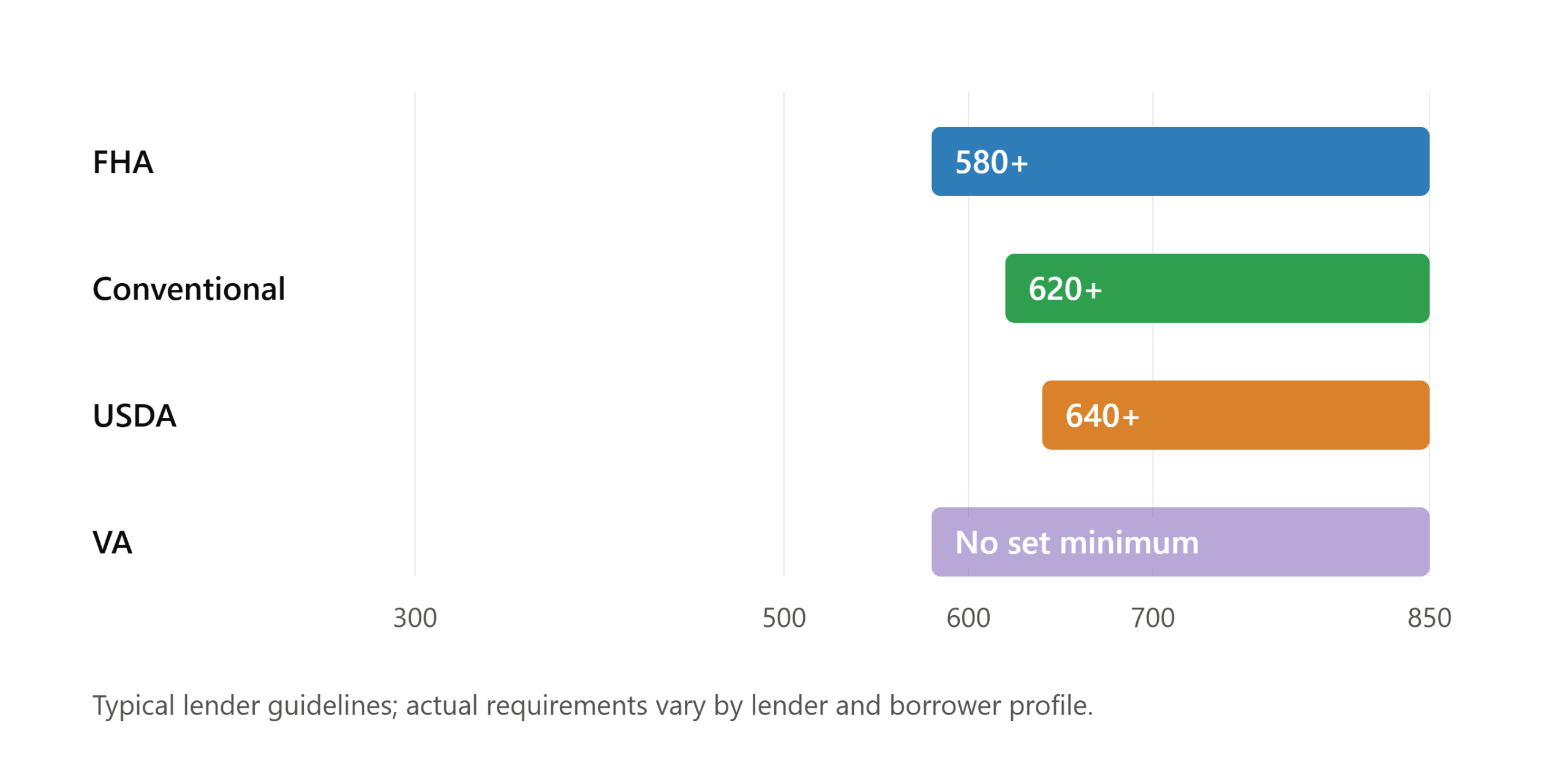
A 620 credit score is often used as a general benchmark for conventional mortgage eligibility, but there is an important distinction between a minimum eligibility score and the score needed for the most competitive pricing.
A borrower with a 620 score might qualify, while another borrower with a score in the mid-700s may receive a substantially better rate and pricing.
FHA Mortgage Credit Score
FHA loans are insured by the Federal Housing Administration and are designed in part to make homeownership accessible to borrowers who may not qualify as easily for conventional financing.
Under current FHA guidelines, borrowers with a minimum decision credit score of 580 or higher are eligible for maximum financing, while borrowers with scores between 500 and 579 are limited to a maximum 90% loan-to-value ratio.
For a typical FHA purchase with a 580+ score, maximum financing can mean a down payment as low as 3.5%, subject to the FHA’s other requirements. The CFPB confirms that FHA loans can allow down payments as low as 3.5%.
Borrowers with scores from 500 to 579 generally need at least 10% down under FHA’s standard credit-score/LTV rules.
A score below 500 is not eligible for standard FHA-insured mortgage financing under the FHA’s current policy.
VA Mortgage Credit Score
VA loans are designed for eligible veterans, active-duty service members, certain surviving spouses, and other qualifying borrowers.
The VA itself does not establish a single universal minimum credit score for every VA loan in the same way that FHA publishes its 580/500 framework.
However, individual lenders may establish their own credit requirements.
This means a borrower who qualifies for VA benefits should speak with multiple VA-approved lenders rather than assuming that one lender’s credit requirement applies everywhere.
VA financing can be particularly attractive because eligible borrowers may qualify for financing with little or no down payment, depending on their circumstances.
USDA Mortgage Credit Score
USDA mortgage programs are designed to help eligible borrowers purchase homes in qualifying rural areas.
USDA loans can be attractive to borrowers who meet the program’s income, property, and eligibility requirements.
Credit requirements can vary depending on the application and underwriting method.
A borrower interested in USDA financing should check current USDA eligibility rules and speak with participating lenders to determine what credit profile is required.
What Is Considered a Good Credit Score for a Mortgage?
A credit score can be viewed in ranges rather than as one magic number.
800–850: Excellent
Borrowers in this range generally have very strong credit profiles.
They may have access to a wide range of mortgage products and competitive interest rates, assuming the rest of their financial profile is strong.
740–799: Very Good
This is generally a strong range for mortgage applicants.
Borrowers may have access to competitive rates and numerous mortgage options.
670–739: Good
Many borrowers in this range can qualify for mortgages.
However, their interest rate may not be as competitive as a borrower with a significantly higher score.
580–669: Fair to Moderate
Mortgage options become more dependent on the loan program, lender, down payment, debt, income, and overall credit history.
FHA financing may be particularly relevant for borrowers who meet the program’s other requirements.
Below 580
Homeownership may still be possible in certain circumstances, but mortgage options can become more limited.
FHA’s current guidelines allow some borrowers with scores between 500 and 579 to qualify with a larger down payment.
Borrowers below 500 generally face significantly greater difficulty obtaining mortgage financing.
Do You Need a 700 Credit Score to Buy a House?
No.
You do not necessarily need a 700 credit score to buy a house.
A 700+ score can put you in a stronger position, but mortgage eligibility depends on the complete loan application.
For example, a borrower with a 620 score, stable income, manageable debt, and an appropriate down payment may qualify for financing.
Another borrower with a 750 score could potentially be denied if they have insufficient income, excessive debt, inadequate assets, or other underwriting problems.
Your credit score matters, but it does not tell the entire story.
Do You Need a 620 Credit Score to Buy a House?
Not necessarily.
A 620 score is often discussed in connection with conventional mortgages, but it is not a universal requirement for all home loans.
Government-backed programs can provide alternatives for borrowers with lower scores.
For example, FHA’s guidelines currently permit certain borrowers with scores between 500 and 579 to obtain FHA financing with a maximum 90% loan-to-value ratio.
Therefore, someone with a credit score below 620 should not automatically assume that homeownership is impossible.
Instead, they should determine which mortgage programs they may qualify for.
How Your Credit Score Affects Your Mortgage Interest Rate
Your credit score can affect more than your ability to qualify.
It can also influence the interest rate and pricing you receive.
The CFPB explains that higher credit scores generally make borrowers eligible for lower interest rates, while borrowers with lower scores may face higher rates and fewer loan choices.
This matters because even a relatively small difference in mortgage rates can result in thousands of dollars of additional interest over many years.
Example
Imagine two borrowers each purchase a $350,000 home with a $315,000 mortgage.
Borrower A has excellent credit and receives a more competitive interest rate.
Borrower B has a lower credit score and receives a higher rate.
Even if both borrowers qualify for the same loan amount, Borrower B could pay considerably more interest over the life of the mortgage.
The exact difference depends on the interest rates available at the time, loan term, fees, points, and other factors.
Credit Score vs. Credit Report
Your credit score is important, but lenders do not look only at the number.
They also examine your credit report.
A credit report can contain information about:
- Payment history
- Credit card accounts
- Installment loans
- Outstanding balances
- Collections
- Public records
- Recent credit inquiries
- Account history
- Delinquencies
- Bankruptcies and other negative information
The CFPB notes that consumers do not have just one credit score. Scores can differ based on the scoring model, information used, source, and timing.
This is particularly important when preparing for a mortgage.
The score you see through a credit-card application or consumer credit-monitoring service may not be identical to the score or scoring model used in mortgage underwriting.
Which Credit Score Do Mortgage Lenders Use?
Mortgage lenders typically review credit information from the major credit reporting companies.
The CFPB explains that most mortgage lenders look at scores from all three major credit reporting companies—Equifax, Experian, and TransUnion—and may use the middle score when determining the borrower’s qualifying score.
This can become particularly important when applying jointly with another borrower.
Your lender may evaluate multiple borrowers’ credit profiles according to applicable underwriting rules.
What Other Factors Do Mortgage Lenders Consider?
Your credit score is only one piece of the mortgage application.
Income
Lenders want to know whether your income is sufficient and stable enough to support the proposed mortgage payment and other obligations.
Employment History
Employment stability can help demonstrate the ability to repay the loan.
Debt-to-Income Ratio
Your debt-to-income ratio, or DTI, compares your monthly debt obligations with your gross monthly income.
A lower DTI generally gives a lender more confidence that you can handle a new mortgage payment.
Down Payment
Your down payment can affect your loan-to-value ratio, monthly mortgage insurance requirements, and overall risk profile.
The CFPB notes that a larger down payment can improve your chances of obtaining a mortgage and may reduce borrowing costs.
Savings and Assets
Lenders may review bank accounts, investments, retirement assets, and other financial resources.
Property
The home itself must satisfy the applicable requirements for the mortgage program.
Credit History
Two people can have identical credit scores but very different credit histories.
Lenders may examine the reasons behind the score and the overall pattern of repayment.
Can You Buy a House With Bad Credit?
Potentially, yes.
“Bad credit” does not automatically mean you cannot purchase a home.
However, the combination of your credit score, credit history, debt, income, down payment, and loan program becomes especially important.
FHA financing can be one potential option for borrowers with lower credit scores because FHA loans are designed to accommodate borrowers who may have more difficulty qualifying for conventional financing.
The tradeoff is that FHA loans have mortgage insurance requirements and may not always be the cheapest option for borrowers with strong credit and larger down payments.
Can You Buy a House With a 500 Credit Score?
A 500 credit score can potentially qualify for FHA financing under FHA guidelines, but the borrower generally faces a maximum 90% loan-to-value ratio.
That means the borrower would generally need at least 10% down under the FHA’s standard credit-score requirements.
Other underwriting requirements still apply.
A lender may also have additional requirements beyond the FHA’s baseline rules.
Can You Buy a House With a 550 Credit Score?
Potentially.
A 550 score falls within the 500–579 range covered by FHA’s current credit-score guidelines.
However, the borrower would generally need at least a 10% down payment under the FHA’s standard rules, and approval is not guaranteed.
The lender will still evaluate income, debt, credit history, assets, property requirements, and other factors.
Can You Buy a House With a 580 Credit Score?
Yes, potentially.
A 580 score is particularly significant for FHA borrowers because FHA guidelines allow borrowers with a minimum decision credit score of 580 to qualify for maximum financing, subject to the program’s other requirements.
For a typical FHA purchase, this can mean financing up to 96.5% of the adjusted value, corresponding to a 3.5% minimum down payment.
However, a lender can impose additional requirements, and approval is never based on the score alone.
Can You Buy a House With a 600 Credit Score?
A 600 credit score can potentially be sufficient for certain mortgage programs.
FHA financing is one possible route because the FHA’s minimum decision credit score framework allows borrowers from 500 upward, although borrowers below 580 face the 90% maximum LTV limitation.
Conventional financing may be more difficult, depending on the lender and the rest of the application.
Can You Buy a House With a 620 Credit Score?
A 620 credit score can potentially qualify you for conventional financing, depending on the lender and complete application.
However, simply reaching 620 does not necessarily mean you will receive the best available mortgage rate.
A borrower with a significantly higher score may receive more favorable pricing.
The CFPB states that borrowers in the 620–680 range generally face higher rates and fewer choices than borrowers with stronger credit profiles.
Can You Buy a House With a 650 Credit Score?
Yes, potentially.
A 650 score can be sufficient for certain mortgage programs.
However, the interest rate and loan terms you receive can depend on other factors.
If you have time before purchasing, improving your credit score could potentially help you obtain better pricing.
Can You Buy a House With a 700 Credit Score?
Yes.
A 700 credit score is generally considered a strong mortgage credit profile.
However, it does not automatically guarantee the lowest mortgage rate.
Lenders also consider debt, income, loan-to-value ratio, loan type, property type, loan term, and market conditions.
Can You Buy a House With a 750 Credit Score?
Yes.
A 750 score generally puts a borrower in a strong position.
Borrowers in the mid-to-high 700s are generally among those receiving the most competitive mortgage rates, according to the CFPB.
However, even an excellent score does not guarantee approval.
You still need sufficient income, manageable debt, acceptable assets, and a property that meets the applicable requirements.
Does a Higher Credit Score Mean a Lower Down Payment?
Not necessarily.
Credit score and down payment are related to mortgage risk, but one does not automatically replace the other.
For example, FHA financing can allow a 3.5% down payment for borrowers meeting the applicable credit requirements.
The CFPB also notes that a 20% down payment can improve the chances of getting approved and can reduce mortgage insurance costs, although many loan programs permit substantially smaller down payments.
How Much Should You Put Down When Buying a House?
There is no single ideal down payment for every buyer.
Possible down payment amounts include:
- 3%
- 3.5%
- 5%
- 10%
- 15%
- 20%
- More than 20%
A larger down payment can reduce the amount borrowed and may reduce mortgage insurance costs.
However, putting every dollar of savings into the home may leave you without sufficient cash for emergencies, repairs, moving expenses, and other costs.
The best down payment depends on your financial situation.
Does Credit Score Affect Mortgage Insurance?
It can.
The exact impact depends on the mortgage program and insurance structure.
With conventional loans, private mortgage insurance pricing can be affected by factors including credit profile and loan-to-value ratio.
FHA loans have their own mortgage insurance structure.
The CFPB notes that FHA mortgage insurance is required for FHA loans.
Therefore, borrowers should compare the total cost of the mortgage, not simply the interest rate.
How to Improve Your Credit Score Before Buying a House
If you are not planning to purchase immediately, improving your credit can potentially save money.
Pay Every Bill on Time
Payment history is one of the most important components of your credit profile.
Avoid late payments whenever possible.
Reduce Credit Card Balances
High credit utilization can negatively affect your credit profile.
Reducing revolving balances can potentially improve your score.
Avoid Opening Unnecessary Accounts
Opening several new credit accounts before applying for a mortgage can create additional inquiries and may affect your credit profile.
The CFPB recommends avoiding multiple new credit applications in a short period when preparing for a mortgage.
Check Your Credit Reports
Review your credit reports for inaccurate information.
Errors can potentially lower your score and make borrowing more expensive.
Dispute Incorrect Information
If you identify inaccurate information, follow the appropriate dispute process with the credit reporting company and the company that supplied the information.
Keep Older Accounts Open When Appropriate
The length and history of your credit accounts can contribute to your credit profile.
Avoid closing accounts without considering the potential consequences.
Pay Down Debt
Reducing outstanding debt can potentially improve both your credit profile and your debt-to-income ratio.
How Long Does It Take to Improve Your Credit Score?
There is no guaranteed timeline.
Some improvements may appear relatively quickly after creditors report updated balances.
Other negative information can affect your credit for much longer.
The amount of improvement depends on why your score is low.
For example, paying down high credit-card balances may produce a different result from recovering after a serious delinquency, collection, foreclosure, or bankruptcy.
The CFPB notes that credit scores are calculated from information in credit reports, including payment history, debt, account history, credit utilization, new applications, collections, foreclosure, and bankruptcy.
Should You Wait to Buy a House and Improve Your Credit?
Sometimes waiting can make financial sense.
If improving your credit score could substantially reduce your mortgage rate, waiting may save money over the long term.
However, waiting is not always the best choice.
Home prices, interest rates, rent, income, and personal circumstances can change while you wait.
The decision should therefore consider the complete financial picture.
A mortgage professional can help you compare the cost of buying now against the potential benefit of waiting and improving your credit.
How Much Can a Credit Score Change Your Mortgage Payment?
The effect depends on the loan amount and the difference between available interest rates.
For example, suppose you borrow $350,000 for 30 years.
A lower interest rate could result in a significantly lower monthly principal-and-interest payment than a higher rate.
Over several decades, the cumulative interest difference can become substantial.
This is why improving your credit before applying for a mortgage can be financially valuable.
Does Credit Score Affect How Much House You Can Afford?
Indirectly, yes.
Your credit score can affect the interest rate you receive.
The interest rate affects your monthly principal-and-interest payment.
Your payment then affects how much mortgage debt you can potentially qualify for based on the lender’s underwriting criteria.
Therefore, a stronger credit profile can potentially improve purchasing power.
However, income, debt, down payment, taxes, insurance, and lender requirements are also important.
Can You Get a Mortgage With No Credit Score?
Some borrowers may qualify for certain mortgage programs using alternative credit or nontraditional credit histories.
This can be particularly relevant to borrowers who have not used traditional credit products.
However, the requirements can be more complicated, and the borrower should speak with lenders experienced in nontraditional credit underwriting.
Does Checking Your Own Credit Hurt Your Score?
Generally, checking your own credit report is considered a soft inquiry and does not hurt your credit score.
The CFPB specifically notes that requesting your own credit report does not hurt your score.
This means you should feel comfortable monitoring your credit while preparing to buy a home.
Should You Get Preapproved Before Looking for a House?
In many cases, yes.
Mortgage preapproval can help you understand how much you may be able to borrow and can make your offer more credible to sellers.
It also gives you an opportunity to identify potential credit or documentation problems before you find your dream home.
However, preapproval is not the same as final mortgage approval.
Your financial situation and the property will still need to satisfy the lender’s requirements before closing.
How to Prepare Your Credit 6–12 Months Before Buying
If you know you want to purchase a home within the next year, start preparing early.
Six to Twelve Months Before Buying
Focus on:
- Checking your credit reports
- Paying every account on time
- Reducing credit-card balances
- Avoiding unnecessary new credit
- Building savings
- Paying down high-interest debt
- Maintaining stable employment
- Avoiding major financial changes
Three to Six Months Before Buying
Begin:
- Comparing mortgage programs
- Speaking with lenders
- Estimating your budget
- Gathering income documentation
- Reviewing your debt-to-income ratio
- Building your down payment and closing-cost funds
Shortly Before Applying
Avoid:
- Taking out a car loan unnecessarily
- Opening multiple credit cards
- Making unusually large unexplained deposits
- Changing jobs without understanding the implications
- Taking on significant new debt
The goal is to present lenders with a stable and understandable financial profile.
Credit Score Mistakes to Avoid Before Applying for a Mortgage
Applying for Too Much New Credit
Multiple new applications can affect your credit profile.
Financing a New Car
A new auto loan increases your monthly debt obligation and can affect your mortgage qualification.
Running Up Credit Cards
High balances can increase credit utilization and debt.
Missing Payments
A new late payment can seriously damage an otherwise strong credit profile.
Closing Credit Accounts Without Planning
Closing an account can sometimes affect your utilization and credit history.
Ignoring Credit Report Errors
An inaccurate account can unnecessarily reduce your mortgage credit profile.
What If Your Credit Score Is Too Low?
Don’t immediately give up on homeownership.
Instead, consider the following:
Talk to Multiple Lenders
Different lenders may have different underwriting approaches and loan offerings.
Consider FHA Financing
FHA may provide an option for borrowers with lower credit scores who meet the program’s requirements.
Increase Your Down Payment
A larger down payment can strengthen an application and reduce the loan-to-value ratio.
Reduce Your Debt
Lower monthly debt payments can improve your debt-to-income ratio.
Wait and Improve Your Credit
If buying is not urgent, improving your credit may make the mortgage less expensive.
Can a Co-Borrower Help?
A qualified co-borrower may strengthen an application in some circumstances.
However, adding another borrower does not automatically solve credit problems.
The lender will generally evaluate the financial profiles of all borrowers according to the applicable underwriting rules.
A co-borrower can also become legally responsible for the mortgage debt.
Therefore, this decision should be considered carefully.
Credit Score vs. Income: Which Matters More?
Neither can be considered independently.
A high credit score does not compensate for insufficient income.
Likewise, a high income does not automatically overcome serious credit problems.
Mortgage underwriting evaluates the complete financial picture.
A lender wants to determine whether you have both the ability and willingness to repay the mortgage.
What Credit Score Should You Aim For?
If you are planning to buy a house, a reasonable goal is to make your credit as strong as possible before applying.
There is no need to obsess over reaching an exact number such as 800.
Instead, focus on:
- On-time payments
- Low credit utilization
- Stable accounts
- Limited new credit applications
- Accurate credit reports
- Manageable debt
The CFPB notes that borrowers with mid-to-high 700s generally receive the lowest mortgage rates, but borrowers below that range can still qualify for mortgages depending on the loan program and financial circumstances.
Credit Score Mortgage Guide
| Credit Score | General Mortgage Position |
|---|---|
| 800–850 | Excellent; potentially strongest pricing |
| 760–799 | Very strong |
| 740–759 | Strong |
| 700–739 | Good |
| 680–699 | Generally good, but pricing may vary |
| 620–679 | Possible mortgage eligibility; fewer options and potentially higher rates |
| 580–619 | FHA may be an important option |
| 500–579 | FHA may be possible with higher down payment |
| Below 500 | Mortgage options become very limited |
This table is a general educational guide, not a guarantee of approval or pricing. Actual requirements vary by mortgage program, lender, borrower, property, and market conditions.
Frequently Asked Questions
What is the minimum credit score to buy a house?
There is no universal minimum. Different mortgage programs have different requirements. FHA guidelines currently allow maximum financing at 580 or higher and limit borrowers with scores from 500–579 to 90% LTV. Conventional lenders often use higher minimums, while VA and USDA requirements can vary by lender and program.
Is 620 a good credit score to buy a house?
A 620 score can potentially qualify for some conventional mortgages, but it may result in fewer choices and higher pricing than a stronger score. The CFPB identifies the 620–680 range as one where borrowers generally face higher rates and fewer choices.
Can I buy a house with a 580 credit score?
Yes, potentially. FHA guidelines allow borrowers with a minimum decision credit score of 580 to qualify for maximum FHA financing, subject to other requirements.
Can I buy a house with a 550 credit score?
Potentially through FHA financing. A 550 score falls within the FHA 500–579 range, which generally requires a maximum 90% LTV, meaning at least 10% down under the standard FHA framework.
Is 700 a good credit score for a mortgage?
Yes. A 700 score is generally a strong credit profile, although the best mortgage pricing is typically associated with even stronger credit profiles and depends on the complete application.
Is 750 a good credit score to buy a house?
Yes. A 750 score generally puts a borrower in a strong position for mortgage financing and competitive pricing, assuming other financial factors are favorable.
Do I need 20% down if my credit score is low?
Not necessarily. Some mortgage programs allow significantly smaller down payments. FHA financing, for example, can allow 3.5% down for borrowers meeting its applicable credit requirements, while borrowers in the 500–579 range generally face a 10% minimum under FHA’s standard rules.
Does paying off debt increase my credit score?
It can, particularly if you reduce high credit-card utilization, although the exact effect varies from person to person.
Does checking my credit before buying a house hurt my score?
Checking your own credit report does not hurt your score.
Can I get a mortgage with bad credit?
Possibly. FHA and certain other mortgage programs may provide options for borrowers who do not qualify as easily for conventional financing.
Should I improve my credit before applying for a mortgage?
If you have time, improving your credit can potentially increase your mortgage options and help you qualify for better pricing.
What credit score gets the best mortgage rate?
There is no universal score that guarantees the best rate. However, the CFPB says the lowest rates generally go to borrowers with scores in the mid-to-high 700s or above.
Final Thoughts
So, what credit score do you need to buy a house?
The answer depends on the mortgage program and your overall financial profile.
A credit score around 620 can be an important benchmark for some conventional borrowers, while FHA financing can accommodate lower scores under its guidelines. Borrowers with a score of 580 or higher may qualify for maximum FHA financing, while those between 500 and 579 may qualify with a larger down payment.
But the goal should not simply be reaching the minimum score.
A stronger credit profile can potentially give you more mortgage choices, better interest rates, lower borrowing costs, and greater negotiating flexibility.
Before buying a home, check your credit reports, pay bills on time, reduce high credit-card balances, avoid unnecessary new debt, save for your down payment and closing costs, and compare mortgage offers from multiple lenders.
Remember that credit score is only one part of mortgage approval. Your income, employment, debt, assets, down payment, property, and overall credit history all matter.
If your score is not where you want it to be today, homeownership may still be possible. The important step is understanding which loan programs fit your circumstances and determining whether improving your credit before buying could save you money.

Seraphina Vale is a passionate content writer and blogger with 3 years of blogging experience, specializing in creating engaging, well-researched, and reader-focused articles. She enjoys breaking down complex topics into clear, practical insights that help readers stay informed and make confident decisions.