Buying a home is one of the largest financial commitments most Americans make, and understanding your monthly mortgage payment is one of the most important steps before purchasing a property.
Many homebuyers look at the price of a house and the advertised mortgage interest rate and assume they can estimate their payment from those two numbers alone. In reality, your total monthly housing payment can include several different expenses. Principal and interest are the core components of the mortgage, but property taxes, homeowners insurance, mortgage insurance, and sometimes other property-related costs can significantly increase the amount you actually pay each month.
This is why a mortgage payment calculator is such a useful tool.
A mortgage calculator allows you to estimate how much your home loan could cost based on factors such as the purchase price, down payment, loan amount, interest rate, and repayment term. More detailed calculators can also account for property taxes, homeowners insurance, mortgage insurance, and HOA or condominium fees.
The Consumer Financial Protection Bureau (CFPB) explains that the total monthly payment sent to a mortgage company is often higher than principal and interest because it can include homeowners insurance, property taxes, and mortgage insurance.
For many buyers, understanding the difference between principal and interest and the total monthly mortgage payment can make the difference between buying a home comfortably and taking on a payment that stretches the household budget too far.
This complete U.S. mortgage payment calculator guide explains how monthly mortgage payments are calculated, what PITI means, how taxes and insurance affect your payment, how escrow works, how PMI fits into the calculation, and how to estimate your total housing cost before buying a home.
What Is a Mortgage Payment Calculator?
A mortgage payment calculator is a financial tool that estimates the monthly cost of a home loan.
A basic calculator usually requires:
- Home price or loan amount
- Down payment
- Mortgage interest rate
- Loan term
A more advanced mortgage calculator may also include:
- Property taxes
- Homeowners insurance
- Mortgage insurance
- HOA fees
- Condo fees
Fannie Mae’s mortgage calculator, for example, allows users to enter the purchase price, down payment, loan term, and interest rate and can estimate taxes, homeowners insurance, mortgage insurance, and HOA or condo fees.
The result is an estimate rather than a mortgage approval.
Your actual payment will depend on the mortgage you qualify for, the rate you receive, the property, taxes, insurance costs, loan structure, and other factors.
What Does PITI Mean?
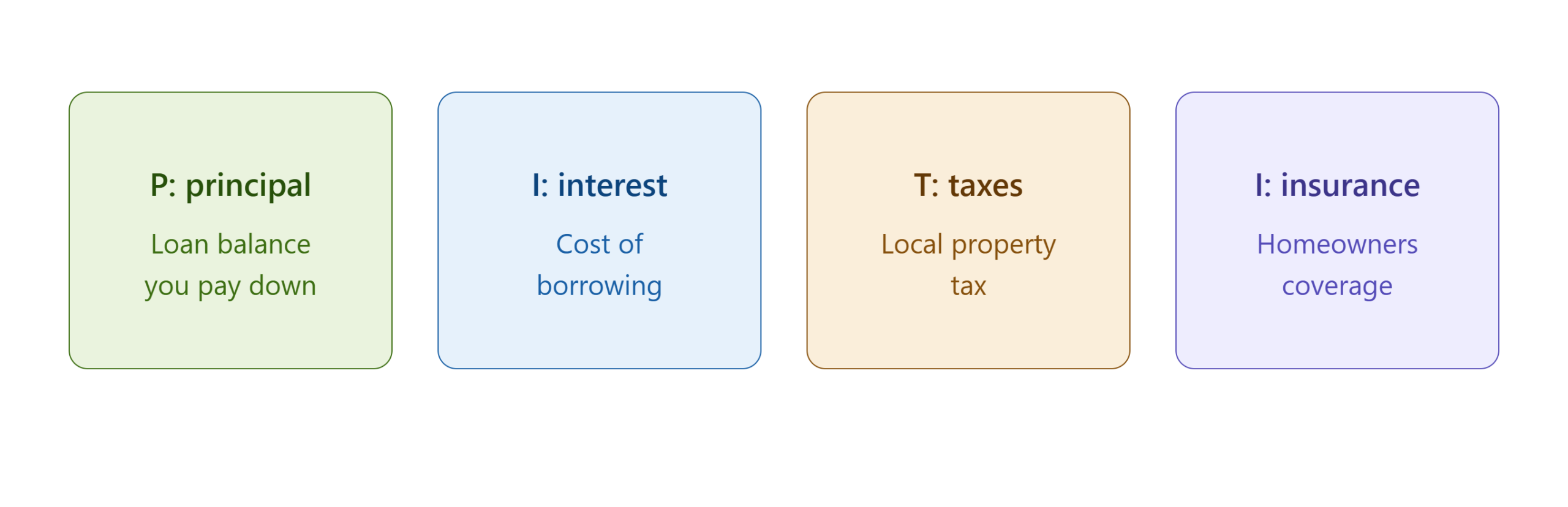
PITI stands for:
P — Principal
I — Interest
T — Taxes
I — Insurance
These are the four basic elements commonly associated with a mortgage payment. The CFPB specifically defines PITI as principal, interest, taxes, and insurance.
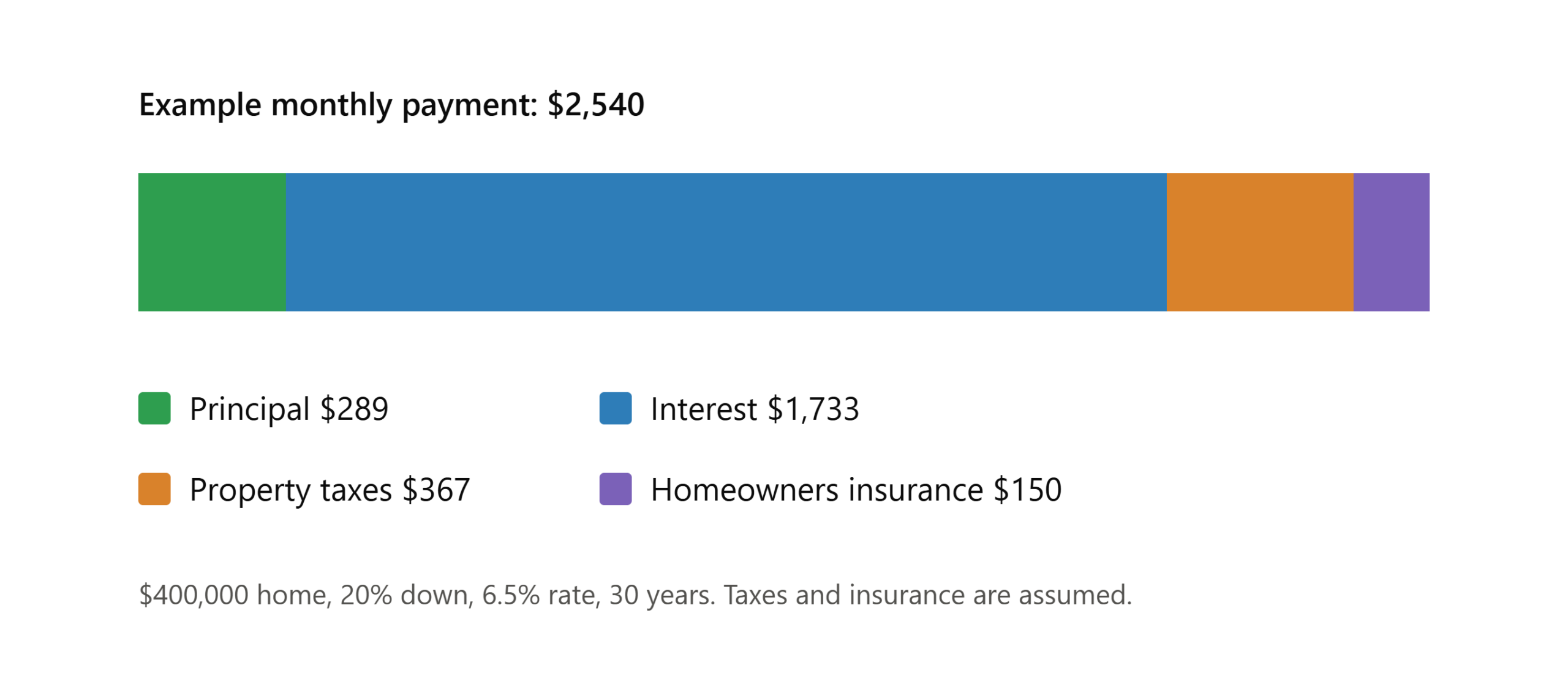
However, your actual monthly housing expense may also include mortgage insurance and other costs.
A practical formula is:
Total Monthly Mortgage Payment = Principal + Interest + Property Taxes + Homeowners Insurance + Mortgage Insurance + Other Applicable Costs
HOA or condominium fees are often separate from the mortgage payment, although they should still be included when determining your total housing budget.
What Is Principal?
The principal is the amount of money you borrow to purchase the home.
For example, suppose you purchase a home for:
$400,000
and make a:
$80,000 down payment
Your initial mortgage principal would be:
$320,000
The principal represents the amount you owe the lender before considering interest and other costs.
As you make mortgage payments, part of each payment is applied toward reducing the principal.
Reducing your principal increases the amount of home equity you own, assuming other factors such as the home’s market value are unchanged.
The CFPB explains that principal is the amount borrowed and that the portion of your payment applied to principal reduces your mortgage balance.
What Is Mortgage Interest?
Interest is the cost of borrowing money from the lender.
If you borrow $320,000, you do not simply repay $320,000.
You also pay interest according to the mortgage’s interest rate and repayment schedule.
For a fixed-rate mortgage, the principal-and-interest payment is generally calculated so that the loan is fully repaid at the end of the agreed term if you make the required payments.
The amount of interest you pay depends on:
- Loan amount
- Interest rate
- Loan term
- Payment schedule
- How quickly you reduce the principal
A lower interest rate can significantly reduce the total cost of borrowing.
What Are Property Taxes?
Property taxes are taxes imposed by state or local governments on real estate.
Property-tax rates and assessment practices vary significantly across the United States.
Two homes with identical purchase prices can have very different property-tax bills depending on where they are located.
For example, a $400,000 home in one county may have a substantially different annual property-tax bill from a $400,000 home in another county.
This is why a mortgage calculator should allow you to enter the actual or estimated property taxes for the property you are considering.
Fannie Mae notes that property taxes are determined by local governments and can vary according to location and property value.
How to Calculate Monthly Property Taxes
Suppose annual property taxes are:
$6,000 per year
Divide by 12:
$6,000 ÷ 12 = $500 per month
You can then add approximately $500 to your estimated monthly housing cost.
If your taxes are paid through escrow, your lender or mortgage servicer generally collects this amount as part of your monthly payment.
What Is Homeowners Insurance?
Homeowners insurance helps protect against covered losses involving the home and certain personal-property or liability risks, depending on the policy.
Insurance costs vary based on factors such as:
- Location
- Home value
- Home age
- Construction
- Coverage limits
- Deductible
- Claims history
- Local risks
Fannie Mae notes that homeowners insurance rates can depend on factors including the home’s size, age, location, and deductible.
Example
Suppose homeowners insurance costs:
$2,400 per year
Your estimated monthly insurance cost would be:
$2,400 ÷ 12 = $200
That $200 can be added to your estimated monthly housing cost.
What Is Mortgage Insurance?
Mortgage insurance protects the lender against certain losses if the borrower fails to repay the mortgage.
For conventional loans, private mortgage insurance (PMI) may be required when the down payment is below a certain threshold, commonly 20%.
Fannie Mae notes that mortgage insurance may be required when the down payment is less than 20%, depending on the loan.
Government-backed mortgages can have different mortgage-insurance rules.
For example, FHA loans have their own mortgage insurance structure.
Mortgage insurance can add a meaningful amount to your monthly housing expense, so it should be included when estimating affordability.
What Is Escrow?
An escrow account is an account managed by the mortgage lender or servicer to collect and pay certain property-related expenses.
Instead of receiving a large property-tax or insurance bill and paying the entire amount yourself, you may contribute a portion each month through your mortgage payment.
The servicer then uses the escrow funds to pay eligible bills when they become due.
Example of Escrow
Suppose your annual costs are:
Property taxes: $6,000
Homeowners insurance: $2,400
Total annual escrow expenses:
$8,400
Divide by 12:
$700 per month
Your mortgage payment could therefore include approximately $700 per month for taxes and insurance, subject to the actual bills and escrow requirements.
Why Can Your Mortgage Payment Change?
A common misconception is that a mortgage payment can never change after closing.
With a typical fixed-rate mortgage, the principal-and-interest payment generally remains stable.
However, your total monthly payment can change if other components change.
For example:
- Property taxes can increase.
- Homeowners insurance premiums can increase.
- Mortgage insurance can change or eventually end depending on the loan.
- HOA fees can increase.
- An adjustable-rate mortgage can have changing principal-and-interest payments.
The CFPB specifically notes that escrow payments can change when property taxes or insurance costs change.
How Is a Mortgage Payment Calculated?
For a standard fixed-rate mortgage, the principal-and-interest payment is calculated using the loan amount, interest rate, and repayment term.
The standard formula is:
M = P × [r(1+r)^n] ÷ [(1+r)^n − 1]
Where:
- M = monthly principal-and-interest payment
- P = principal loan amount
- r = monthly interest rate
- n = total number of monthly payments
To calculate the monthly interest rate, the annual interest rate is generally divided by 12.
For example:
6.00% ÷ 12 = 0.50% per month
A 30-year mortgage has:
30 × 12 = 360 monthly payments
Mortgage calculators perform this calculation automatically.
Mortgage Payment Example
Consider a hypothetical home purchase:
Home price: $400,000
Down payment: $80,000
Loan amount: $320,000
Interest rate: 6.00%
Loan term: 30 years
At 6.00%, the estimated monthly principal-and-interest payment is approximately:
$1,919
That is not necessarily the total monthly mortgage payment.
Now suppose:
Property taxes: $6,000 annually
Homeowners insurance: $2,400 annually
Property taxes per month:
$500
Insurance per month:
$200
Estimated PITI:
$1,919 + $500 + $200 = $2,619 per month
If mortgage insurance applies, the payment could be higher.
If the property has an HOA fee, your total monthly housing expense could be higher still.
Example: Full Monthly Mortgage Payment
Let’s expand the example.
Home Purchase
Home price:
$400,000
Down payment:
$80,000
Mortgage:
$320,000
Mortgage
Interest rate:
6.00%
Term:
30 years
Estimated principal and interest:
$1,919/month
Taxes
Annual property taxes:
$6,000
Monthly estimate:
$500
Insurance
Annual homeowners insurance:
$2,400
Monthly estimate:
$200
Mortgage Insurance
Assume:
$0
Estimated Total
$1,919 + $500 + $200 = $2,619/month
Therefore, the estimated monthly PITI payment would be:
$2,619
This is only an example. Actual taxes, insurance, mortgage rates, mortgage insurance, and other costs vary by borrower and property.
Principal and Interest vs. Total Mortgage Payment
This distinction is extremely important.
Suppose your principal-and-interest payment is:
$1,919
You might think your mortgage payment is $1,919.
But if you also pay:
$500 taxes
and
$200 insurance
your actual payment to the mortgage servicer could be approximately:
$2,619
The CFPB warns that homebuyers can underestimate their housing costs if they look only at principal and interest instead of the total monthly payment.
How Amortization Changes Your Payment
A typical fixed-rate mortgage uses an amortization schedule.
Although your scheduled principal-and-interest payment generally remains the same, the amount allocated to interest versus principal changes over time.
At the beginning of the loan, the outstanding balance is high.
Therefore, more of the payment goes toward interest.
As the principal balance decreases, the amount of interest charged each month decreases.
More of the payment can then be applied to principal.
The CFPB describes this process as amortization.
Mortgage Payment Example Over Time
Suppose you have a $320,000 mortgage at 6.00% for 30 years.
Your monthly principal-and-interest payment is approximately:
$1,919
During the early years, a relatively large portion of that payment goes toward interest.
Later in the mortgage, a larger portion goes toward principal.
This is why homeowners should not assume that the first several years of payments reduce the mortgage balance by the same amount as the later years.
How Loan Term Affects Your Monthly Payment
The mortgage term has a major impact on your payment.
The most common fixed-rate terms include:
- 30 years
- 20 years
- 15 years
- 10 years
30-Year Mortgage
A 30-year mortgage generally offers a lower monthly principal-and-interest payment.
The tradeoff is that you typically pay interest over a longer period.
15-Year Mortgage
A 15-year mortgage generally has a higher monthly payment.
However, the loan is paid off faster, and the borrower may pay substantially less total interest.
Fannie Mae similarly notes that longer loan terms generally reduce monthly principal payments but result in more interest paid over the life of the loan.
Example: 30-Year vs. 15-Year Mortgage
Imagine borrowing:
$300,000
At:
6.00%
A 30-year mortgage would have a lower monthly principal-and-interest payment than a 15-year mortgage.
However, the 15-year loan would require much larger monthly payments while allowing the borrower to eliminate the mortgage much sooner.
This demonstrates an important principle:
Lower monthly payment does not necessarily mean lower total cost.
How the Down Payment Affects Your Mortgage Payment
The down payment directly affects how much you borrow.
Suppose a home costs:
$400,000
5% Down
Down payment:
$20,000
Loan:
$380,000
10% Down
Down payment:
$40,000
Loan:
$360,000
20% Down
Down payment:
$80,000
Loan:
$320,000
The larger down payment reduces the loan amount and therefore generally reduces principal and interest.
A larger down payment can also affect mortgage insurance requirements and costs.
However, buyers should not drain their savings simply to reach a particular down-payment percentage.
How Interest Rate Affects Your Payment
The mortgage interest rate can have a significant impact on monthly payment.
Suppose you borrow:
$320,000
for:
30 years
A mortgage at 5% will have a lower principal-and-interest payment than the same mortgage at 7%.
This is why comparing mortgage rates from multiple lenders can be valuable.
However, borrowers should compare the complete loan offer rather than focusing only on the advertised rate.
The CFPB recommends reviewing Loan Estimates from multiple lenders to compare monthly payments and loan costs.
How Property Taxes Affect Mortgage Payments
Property taxes can make a significant difference in affordability.
Consider two homes that each cost:
$400,000
Suppose Home A has annual property taxes of:
$4,000
Home B has annual property taxes of:
$8,000
The difference is:
$4,000 per year
or:
$333.33 per month
Therefore, even though the homes have identical purchase prices, Home B could cost more than $333 per month extra simply because of property taxes.
This is why homebuyers should research the actual tax bill for the property they want to purchase.
How Homeowners Insurance Affects Your Payment
Insurance can also vary considerably by property and location.
Factors can include:
- Home replacement cost
- Location
- Weather and disaster risk
- Age of the property
- Roof condition
- Deductible
- Coverage level
- Claims history
A mortgage calculator can use an estimated annual insurance amount, but buyers should obtain actual insurance quotes before finalizing their budget.
What About HOA Fees?
Homeowners association fees are an important housing expense that may not be included in your mortgage payment.
For example, suppose your estimated mortgage payment is:
$2,600/month
and your HOA fee is:
$250/month
Your housing expense becomes:
$2,850/month
HOA fees can cover services such as landscaping, exterior maintenance, community amenities, or other shared expenses.
Fannie Mae notes that HOA and condominium fees are generally collected separately from the mortgage payment.
What About Condo Fees?
Condominium owners may have monthly or quarterly association fees.
These fees should be included in your affordability calculation even when they are not part of the mortgage payment sent to your lender.
Before buying a condo, investigate:
- Monthly association fee
- Special assessments
- Reserve funds
- Association rules
- Insurance coverage
- Recent fee increases
Mortgage Payment Calculator: What Information Do You Need?
To get a useful estimate, gather:
Home Price
The purchase price of the property.
Down Payment
The amount you plan to pay upfront.
Loan Amount
The amount you intend to finance.
Interest Rate
Your estimated or offered mortgage rate.
Loan Term
For example:
30 years
or
15 years
Property Taxes
Use the actual tax bill when possible.
Homeowners Insurance
Obtain an insurance quote for a more realistic estimate.
Mortgage Insurance
Include PMI or other applicable mortgage insurance.
HOA Fees
Add monthly HOA or condominium fees to your overall housing budget.
Mortgage Payment Calculator Example
Let’s consider another hypothetical purchase.
Home price: $500,000
Down payment: $100,000
Loan: $400,000
Interest rate: 6.00%
Term: 30 years
Estimated principal and interest:
Approximately $2,398/month
Now suppose:
Property taxes: $7,500/year
Monthly taxes:
$625
Homeowners insurance:
$2,400/year
Monthly insurance:
$200
Estimated PITI:
$2,398 + $625 + $200
= $3,223/month
If the home has:
$150/month HOA
your broader monthly housing expense becomes approximately:
$3,373/month
And this is before considering maintenance, utilities, repairs, or other ownership expenses.
Why the Calculator Result Is Only an Estimate
A mortgage calculator is a planning tool, not a loan approval tool.
The actual mortgage payment can differ because:
- Your actual interest rate may differ.
- Property taxes can change.
- Insurance costs can differ.
- PMI may apply.
- The lender may require escrow.
- The loan structure may be different.
- HOA fees may change.
- Your final loan amount may differ.
Fannie Mae specifically warns that calculator results are estimates and do not indicate mortgage approval or financing.
How to Use a Mortgage Calculator Before Buying
The best way to use a mortgage calculator is to test multiple scenarios.
Don’t calculate only one payment.
Try:
Scenario 1: 5% Down
Calculate the payment with a smaller down payment.
Scenario 2: 10% Down
Compare the result.
Scenario 3: 20% Down
Determine how much the payment changes and whether mortgage insurance is reduced or eliminated under the applicable loan.
Scenario 4: Higher Interest Rate
Test what happens if your rate is one or two percentage points higher than expected.
Scenario 5: Higher Property Taxes
Increase the estimated tax bill.
Scenario 6: Higher Insurance
Test a more conservative insurance estimate.
This stress-testing approach gives you a better idea of whether the home is comfortably affordable.
How to Calculate the Maximum Home Price You Can Afford
A mortgage calculator can also work backward.
Instead of starting with:
Home price → monthly payment
you can start with:
Affordable monthly payment → estimated loan amount → estimated home price
The CFPB recommends estimating your total monthly housing budget, accounting for property taxes and homeowners insurance, and then determining how much you can afford for principal and interest.
For example, if you decide you can comfortably spend:
$2,500 per month
on total mortgage-related housing costs, you should not simply enter $2,500 as your principal-and-interest budget.
First subtract estimated taxes, insurance, mortgage insurance, and other applicable costs.
Mortgage Payment vs. Total Cost of Homeownership
Your mortgage payment is not your complete cost of owning a home.
You should also budget for:
- Utilities
- Repairs
- Maintenance
- Landscaping
- Pest control
- Appliance replacement
- Roof repairs
- HVAC maintenance
- HOA fees
- Home improvements
- Emergency expenses
Fannie Mae specifically recommends considering maintenance, unexpected expenses, moving costs, and other homeownership costs when determining affordability.
What Is a Comfortable Mortgage Payment?
There is no universal payment that is comfortable for every household.
Two households earning the same income may have completely different financial situations.
One may have:
- Student loans
- Auto loans
- Credit-card debt
- Childcare expenses
while another may have very little debt.
Your mortgage should fit your complete financial situation.
Instead of asking:
“How much will the lender approve me for?”
ask:
“How much can I comfortably afford while still saving, investing, handling emergencies, and enjoying my life?”
Mortgage Calculator and Debt-to-Income Ratio
Mortgage lenders commonly evaluate debt-to-income ratio (DTI) when assessing borrowers.
DTI compares monthly debt obligations with gross monthly income.
For example, suppose your gross monthly income is:
$8,000
and your qualifying monthly debt payments total:
$3,000
Your DTI would be:
$3,000 ÷ $8,000 = 37.5%
The specific DTI requirements vary by loan type and lender.
A mortgage calculator can help estimate the proposed housing payment, but it does not determine whether you qualify.
What Is Included in the Loan Estimate?
After applying for a mortgage, the lender generally provides a Loan Estimate within three business days.
The Loan Estimate includes information about the estimated interest rate, monthly payment, closing costs, taxes, insurance, and other loan terms.
The CFPB recommends reviewing the estimated total monthly payment rather than looking only at principal and interest.
This makes the Loan Estimate an important document for comparing your calculator estimate with the actual mortgage offer.
Mortgage Calculator vs. Loan Estimate
A mortgage calculator is useful before and during the shopping process.
A Loan Estimate becomes important once you actually apply for a mortgage.
Mortgage Calculator
Useful for:
- Budgeting
- Comparing home prices
- Comparing interest rates
- Testing down payments
- Estimating payments
Loan Estimate
Useful for:
- Reviewing an actual mortgage offer
- Comparing lender costs
- Checking projected payments
- Reviewing taxes and insurance estimates
- Understanding closing costs
- Comparing loan terms
You should use both.
What Is the Difference Between Monthly Payment and Cash to Close?
These are completely different numbers.
Monthly Payment
This is the recurring amount you pay toward the mortgage and applicable escrowed costs.
Cash to Close
This is the amount you generally need to bring to closing after accounting for your down payment, closing costs, credits, deposits, and other adjustments.
The CFPB’s Loan Estimate and Closing Disclosure tools distinguish between the estimated total monthly payment and cash to close.
A buyer therefore needs to plan for both.
Common Mortgage Calculator Mistakes
Mistake 1: Looking Only at Principal and Interest
This can make your housing payment appear lower than it actually is.
Mistake 2: Ignoring Property Taxes
Taxes can represent hundreds of dollars per month.
Mistake 3: Ignoring Insurance
Insurance is another recurring housing expense.
Mistake 4: Forgetting PMI
A smaller down payment may result in mortgage insurance costs.
Mistake 5: Ignoring HOA Fees
HOA fees can materially increase monthly housing expenses.
Mistake 6: Using Unrealistically Low Interest Rates
Use a realistic rate range rather than assuming you will receive the lowest advertised rate.
Mistake 7: Forgetting Maintenance
A mortgage calculator cannot predict every repair or maintenance expense.
Mistake 8: Assuming the Payment Never Changes
Even with a fixed-rate mortgage, taxes and insurance can change.
Mistake 9: Assuming Calculator Results Mean Approval
A calculator cannot approve your mortgage.
Fannie Mae explicitly states that calculator results do not indicate approval or financing.
How to Lower Your Monthly Mortgage Payment
If your estimated payment is too high, consider several options.
Increase Your Down Payment
Borrowing less can reduce principal and interest.
Choose a Lower-Priced Home
Reducing the purchase price can lower the mortgage amount.
Shop for a Better Mortgage Rate
Comparing multiple lenders may help you find more competitive terms.
Consider a Longer Loan Term
A longer term can reduce the monthly principal-and-interest payment, although it generally increases total interest paid.
Reduce Mortgage Insurance
Depending on the loan type, a larger down payment may reduce or eliminate certain mortgage insurance costs.
Consider Property Taxes and Insurance
Two homes with similar prices can have significantly different ongoing costs.
How to Lower the Total Cost of Your Mortgage
Lowering your monthly payment is not always the same thing as lowering your total mortgage cost.
To reduce total borrowing costs, consider:
- Lower interest rate
- Shorter loan term
- Larger down payment
- Fewer unnecessary fees
- Avoiding excessive points unless they make financial sense
- Making additional principal payments when appropriate
A 15-year mortgage may have a higher monthly payment but significantly lower lifetime interest than a 30-year mortgage.
Should You Pay Extra Toward Principal?
Making additional principal payments can reduce the outstanding balance faster.
Because future interest is calculated based on the remaining balance, paying down principal can reduce future interest costs.
However, you should first consider:
- Emergency savings
- High-interest debt
- Retirement contributions
- Investment goals
- Prepayment terms, if any
- Other financial priorities
Not every homeowner should prioritize early mortgage payoff over all other financial goals.
How Property Taxes Can Change Your Payment
Suppose your mortgage payment initially includes:
$500/month property taxes
If your annual tax bill increases from:
$6,000 → $7,200
your monthly tax estimate becomes:
$600
That is an additional:
$100/month
Your mortgage interest rate did not change.
Your principal-and-interest payment did not change.
But your total monthly payment increased because your property taxes changed.
This is one reason escrow payments can change over time.
How Insurance Can Change Your Payment
The same concept applies to homeowners insurance.
Suppose your annual insurance premium rises from:
$2,400 → $3,000
Monthly cost:
$3,000 ÷ 12 = $250
If you previously paid $200 per month for insurance, the difference is:
$50/month
Again, your mortgage interest rate did not change, but your total housing payment increased.
Fixed-Rate vs. Adjustable-Rate Mortgage Payments
Mortgage calculators can also help compare fixed-rate and adjustable-rate mortgages.
With a fixed-rate mortgage, the principal-and-interest payment is generally stable.
With an ARM, the initial payment may be fixed for a specific period and can later change according to the loan’s terms.
The CFPB’s mortgage disclosures show that adjustable-rate loans can have projected payment ranges in future periods.
If you are considering an ARM, do not calculate only the initial payment.
Calculate potential future payments as well.
Mortgage Calculator for Refinancing
A mortgage calculator can also help homeowners evaluate refinancing.
For example, you can compare:
Current mortgage payment
versus
Potential refinanced mortgage payment
You should also consider:
- New interest rate
- Remaining loan balance
- New loan term
- Closing costs
- Points
- Prepaid expenses
- Break-even period
A lower monthly payment does not automatically mean refinancing will save money.
Extending a mortgage back to a new 30-year term can lower the payment while potentially increasing the total interest paid.
Frequently Asked Questions
What is PITI in a mortgage?
PITI stands for principal, interest, taxes, and insurance. These are the four basic components commonly associated with a mortgage payment.
What is included in a mortgage payment?
A mortgage payment may include principal, interest, property taxes, homeowners insurance, and mortgage insurance. HOA or condo fees are generally separate.
How do I calculate my monthly mortgage payment?
You need the loan amount, interest rate, and loan term to calculate principal and interest. Then add estimated property taxes, homeowners insurance, mortgage insurance, and other applicable costs.
Does a mortgage calculator include taxes and insurance?
Some calculators include them and some do not. Advanced calculators can include property taxes, homeowners insurance, mortgage insurance, and HOA fees.
Is property tax included in my mortgage payment?
It may be. If your lender uses an escrow account, a portion of your monthly payment can be collected for property taxes and homeowners insurance.
Can my mortgage payment increase even with a fixed-rate mortgage?
Yes. The principal-and-interest portion generally remains stable, but property taxes, homeowners insurance, and other costs can change.
What is the difference between principal and interest?
Principal is the amount you borrowed. Interest is the lender’s charge for lending you the money.
Does a larger down payment lower my mortgage payment?
Generally, yes. A larger down payment means you borrow less, which can reduce principal and interest. It can also affect mortgage insurance requirements.
Does a 30-year mortgage have a lower monthly payment than a 15-year mortgage?
Generally, yes. The longer repayment period spreads the principal over more months, reducing the scheduled monthly principal-and-interest payment. However, the borrower generally pays more total interest over the life of the loan.
How much should I spend on a mortgage each month?
There is no single payment that works for everyone. Your housing budget should account for income, debt, savings, taxes, insurance, maintenance, utilities, and other expenses.
Does the mortgage calculator tell me whether I qualify?
No. A mortgage calculator estimates payments. It does not determine mortgage approval.
What is an escrow account?
An escrow account is generally used by a mortgage lender or servicer to collect money for certain property-related expenses, such as taxes and homeowners insurance, and pay those bills when due.
What is PMI?
Private mortgage insurance is insurance that may be required on certain conventional mortgages, commonly when the down payment is less than 20%. The exact requirements and costs depend on the loan.
Should I include HOA fees in my affordability calculation?
Absolutely. Even if the HOA fee is not part of your mortgage payment, it is still a recurring cost of owning the property.
How accurate is a mortgage calculator?
A mortgage calculator can provide a useful estimate, but it is not a guarantee. Your final payment depends on your actual loan terms, rate, taxes, insurance, mortgage insurance, and other costs.
Final Thoughts
A mortgage payment calculator is one of the most useful tools for anyone preparing to buy a home in the United States.
But the most important thing to understand is that your mortgage payment is more than just principal and interest.
A realistic estimate should consider PITI — principal, interest, taxes, and insurance — along with mortgage insurance and other applicable housing expenses.
Start by determining the amount you expect to borrow. Then enter your estimated interest rate and loan term. After calculating principal and interest, add property taxes and homeowners insurance. If applicable, include PMI, HOA fees, and other recurring costs.
For example, a home with a $320,000 mortgage may have a principal-and-interest payment of around $1,919 at a hypothetical 6% 30-year fixed rate. Once taxes and insurance are added, the actual monthly housing cost could be several hundred dollars higher.
That difference is why buyers should never make a purchasing decision based solely on the advertised mortgage payment.
Use the calculator to test different home prices, down payments, interest rates, and loan terms. Then compare those estimates with actual Loan Estimates from lenders. The CFPB recommends reviewing the total monthly payment, loan costs, and other terms when comparing mortgage offers.
Most importantly, focus on what you can comfortably afford, rather than simply what a lender is willing to approve.
A mortgage calculator can tell you what a payment might look like.
Your broader financial plan determines whether that payment is truly affordable.

Seraphina Vale is a passionate content writer and blogger with 3 years of blogging experience, specializing in creating engaging, well-researched, and reader-focused articles. She enjoys breaking down complex topics into clear, practical insights that help readers stay informed and make confident decisions.