
When homeowners receive a roofing estimate, the price of shingles or metal panels is usually easy to understand. Roofing labor costs, however, can be much harder to evaluate. Labor can represent a significant portion of the total cost of a roof repair or replacement, and the amount you pay can vary considerably depending on where you live, the type of roof, the roofing material, the condition of the existing roof, and the complexity of the installation.
In 2026, U.S. homeowners are dealing with a roofing market in which labor rates can differ substantially from one region to another. A roofing contractor in a high-cost metropolitan area may charge considerably more than a contractor serving a lower-cost market. Similarly, replacing a simple asphalt-shingle roof on a single-story home can require far less labor than installing a complicated metal roof on a steep, multi-story property.
Understanding labor costs is therefore important before requesting quotes. A low labor price isn’t necessarily a bargain, and a high labor price isn’t automatically evidence of better workmanship. Homeowners need to understand what the labor charge includes, how contractors calculate their prices, and what additional work could increase the final bill.
This guide explains how roofing labor is priced in the United States, typical labor-cost ranges in 2026, the factors that affect labor prices, differences between repair and replacement labor, and how homeowners can compare roofing estimates more effectively.
What Is Included in Roofing Labor?
Roofing labor covers much more than simply putting shingles on a roof.
Depending on the project, labor can include:
- Measuring and preparing the roof
- Setting up safety equipment
- Removing existing roofing
- Transporting materials around the property
- Installing underlayment
- Installing shingles or panels
- Installing flashing
- Installing vents
- Installing drip edge
- Cutting materials around roof penetrations
- Installing ridge caps
- Cleaning the job site
- Loading and removing roofing debris
A roofing contractor may include many of these tasks in one overall installation price rather than listing each labor activity separately.
How Much Does Roofing Labor Cost in the USA in 2026?
There isn’t one nationwide labor rate that applies to every roofing project.
For many residential roofing projects, labor may represent approximately 30% to 50% of the total roof replacement price, although the percentage can vary significantly depending on the roofing material and project complexity.
A homeowner replacing a standard asphalt-shingle roof may see a relatively straightforward labor component, while a complicated metal, tile, or slate installation can require considerably more specialized labor.
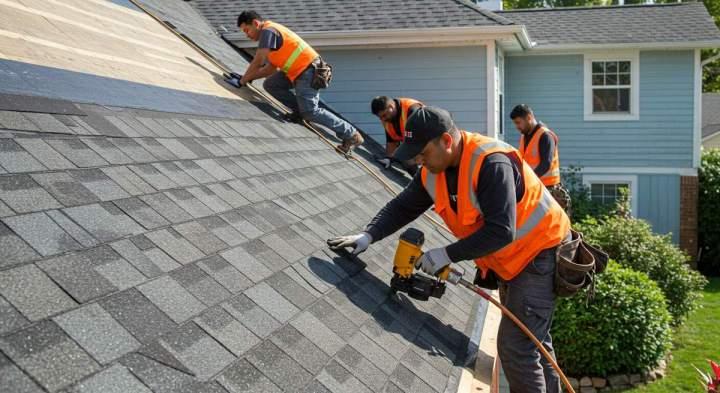
As a broad planning example, if a complete roof replacement costs $12,000, labor might account for approximately $3,600–$6,000 of the project.
These are planning figures, not guaranteed contractor prices.
Roofing Labor Cost Per Square
Roofing contractors commonly use the term “square” when pricing roofing work.
One roofing square equals 100 square feet of roof surface.
For example:
- 10 squares = 1,000 sq. ft.
- 20 squares = 2,000 sq. ft.
- 30 squares = 3,000 sq. ft.
Labor may be priced based partly on the number of roofing squares.
However, contractors don’t necessarily charge the same labor rate for every square. A simple roof might have a lower labor rate, while a steep or complicated roof could require a higher rate.
Typical Roofing Labor Costs by Material
Different roofing materials require different levels of skill and installation time.
Asphalt Shingle Labor
Asphalt shingles generally have relatively straightforward installation requirements.
Typical labor can represent a substantial portion of the total project cost, but the large number of contractors experienced with asphalt shingles helps keep installation relatively competitive.
For a standard residential roof, labor may commonly fall into the range of $2–$5 per square foot, depending on the market and project conditions.
Metal Roofing Labor
Metal roofing typically requires more specialized installation.
Standing-seam systems, for example, can require careful measurements, panel preparation, flashing and fastening.
Labor may commonly fall around $4–$8+ per square foot, depending on the system and complexity.
Tile Roofing Labor
Tile installation is generally more labor-intensive than standard asphalt shingles.
Contractors must carefully position and secure individual tiles while accounting for roof structure, flashing and water drainage.
Labor costs can therefore be significantly higher.
Slate Roofing Labor
Natural slate requires specialized knowledge and experience.
The material is expensive, heavy and relatively fragile during handling.
Installing slate correctly requires specialized tools and techniques, making labor one of the major components of a slate roof’s total cost.
Roofing Labor Cost for Repairs
Roof repairs are usually priced differently from complete replacements.
A contractor may charge:
- A minimum service fee
- An hourly labor rate
- A flat repair price
- A combination of labor and materials
Small repairs can sometimes appear expensive on a per-square-foot basis because the contractor still has travel, inspection, setup and safety costs even when the actual repair is small.
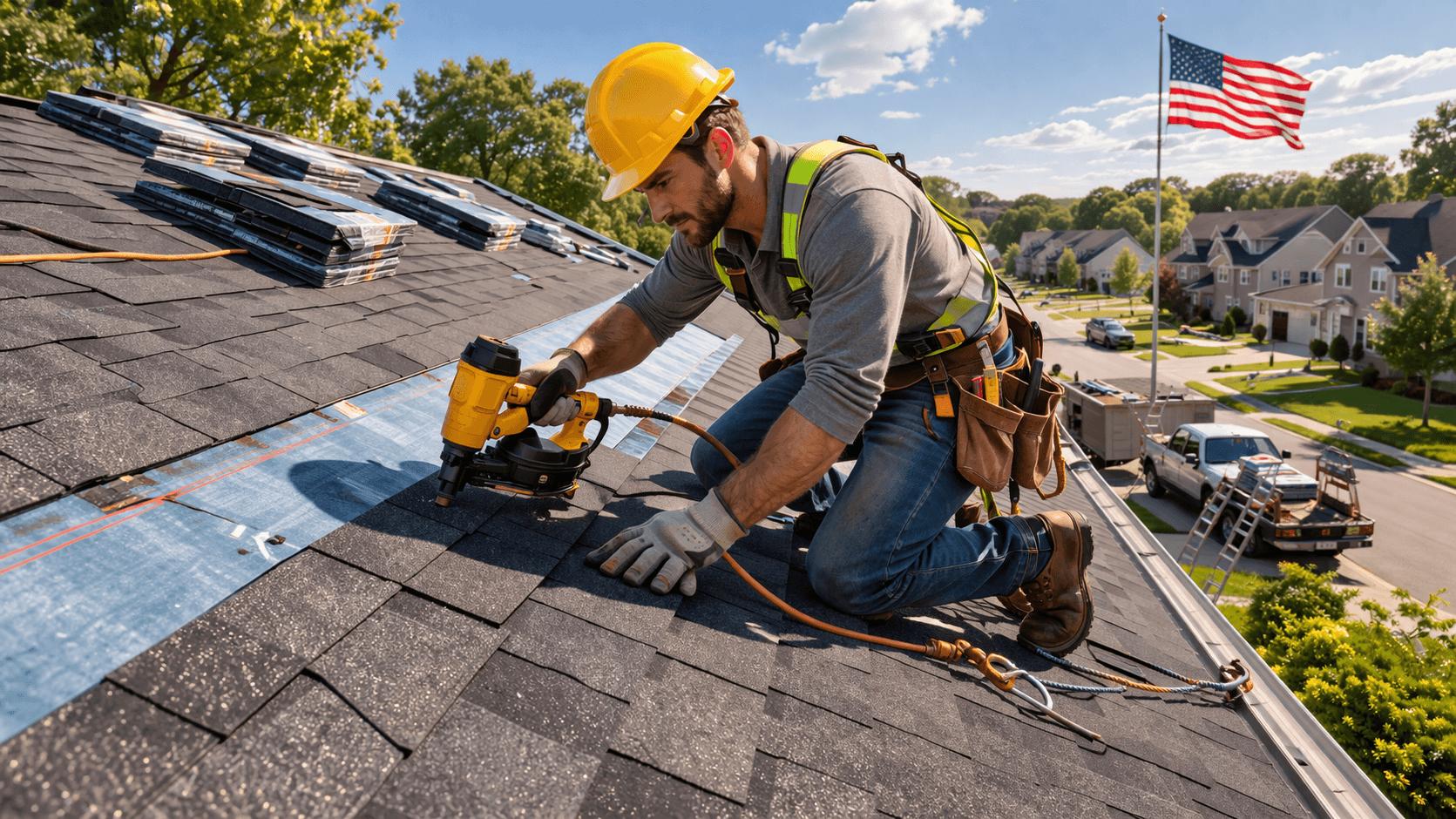
For example, replacing a few damaged shingles may only require a small amount of material, but the contractor still has to travel to the property, inspect the problem, safely access the roof and complete the work.
Emergency Roofing Labor Costs
Emergency repairs can cost more than routine scheduled work.
If a roof is damaged by:
- A severe storm
- Hurricane
- Tornado
- Hail
- Falling tree
- Heavy rain
- Wind
the homeowner may need immediate assistance.
Emergency roofing services can involve additional labor premiums because contractors may need to work outside normal hours or rearrange scheduled projects.
Temporary emergency repairs, such as installing a tarp, may also be necessary before permanent repairs can be completed.
Why Roofing Labor Costs Vary by Location
Location is one of the biggest factors affecting labor prices.
Roofing contractors must account for local:
- Wage levels
- Cost of living
- Business expenses
- Insurance costs
- Licensing requirements
- Building codes
- Permit requirements
- Market demand
- Competition
- Transportation expenses
For this reason, a homeowner should avoid assuming that a roofing quote from another state represents what their local contractor should charge.
Roofing Labor Costs in Major U.S. Markets
Labor costs tend to be higher in expensive metropolitan areas.
For example, homeowners in markets such as New York City, Los Angeles, San Francisco, Boston, Seattle and Washington, D.C. may encounter higher roofing labor rates than homeowners in many lower-cost markets.
However, even within the same metropolitan area, contractor pricing can vary.
Two companies may quote very different prices because they use different crews, materials, warranties, overhead structures and installation methods.
Roof Size and Labor Costs
Larger roofs generally require more labor.
Consider two homes:
Home A: 1,200-square-foot roof
Home B: 3,000-square-foot roof
Home B requires significantly more:
- Roofing material
- Underlayment
- Flashing
- Fasteners
- Installation time
- Cleanup
However, labor doesn’t necessarily increase in a perfectly linear way.
A large but simple roof can sometimes be easier to work on than a smaller roof with numerous valleys, dormers and penetrations.
Roof Pitch and Labor Costs
Roof pitch has a major impact on labor.
A low-slope roof can generally be easier and faster to work on.
A steep roof requires additional:
- Fall protection
- Safety equipment
- Setup time
- Labor
- Experience
Steep roofs may also take longer to install because workers must move carefully and secure materials properly.
As a result, homeowners with steep roofs should expect potentially higher labor costs.
Roof Complexity
Roof complexity can have an even greater effect on labor than size.
A simple rectangular roof is relatively straightforward.
A complicated roof may include:
- Multiple ridges
- Valleys
- Dormers
- Skylights
- Chimneys
- Multiple roof levels
- Different roof pitches
- Numerous vents
- Complex flashing
Every additional feature can increase installation time.
Two-Story Homes and Labor Costs
Two-story houses can be more expensive to roof than single-story homes.
The height increases:
- Safety requirements
- Material handling difficulty
- Setup time
- Equipment requirements
Workers may need additional scaffolding, ladders or specialized safety equipment.
Tear-Off Labor
If you’re replacing an existing roof, the contractor may need to remove the old roofing first.
This is called tear-off.
Tear-off labor can involve:
- Removing old shingles or roofing material.
- Removing old underlayment where necessary.
- Inspecting the decking.
- Removing damaged components.
- Loading debris.
- Transporting debris for disposal.
A roof with several existing layers can require considerably more labor than a roof with only one layer.
Roof Deck Repair and Additional Labor
One of the most important potential surprises during roof replacement is damaged decking.
Once old roofing material is removed, contractors may discover:
- Rot
- Water damage
- Cracked decking
- Structural deterioration
- Mold-related damage
- Weak areas
Replacing damaged decking requires additional labor and materials.
Homeowners should ask contractors how they handle these situations before signing a contract.
Roof Ventilation Labor
Roof ventilation is another area where labor may be required.
Contractors may install or replace:
- Ridge vents
- Soffit vents
- Box vents
- Turbine vents
- Intake vents
Proper ventilation can help manage heat and moisture in the attic.
If your existing ventilation system is inadequate, improving it during a roof replacement may increase the project’s labor cost but could benefit the roofing system over the long term.
Flashing Installation Labor
Flashing is installed around areas where the roof meets another structure or penetration.
Examples include:
- Chimneys
- Skylights
- Walls
- Roof valleys
- Plumbing vents
- Dormers
Flashing must be installed correctly to help prevent water intrusion.
Complex flashing work can require additional labor, especially on older homes.
How Much Does a Roofer Charge Per Hour?
Some roofing contractors use hourly rates for repairs or specialized work.
However, complete roof replacements are often quoted as a project price rather than a simple hourly labor charge.
Hourly rates can vary widely based on:
- Contractor experience
- Region
- Type of work
- Crew size
- Insurance
- Equipment
- Job difficulty
For this reason, homeowners should focus on the complete scope of work and total project price instead of trying to compare hourly rates alone.
Roofing Crew Size
The size of the roofing crew can influence project duration and labor requirements.
A larger crew may complete a standard roof replacement more quickly.
A smaller crew may require more days.
However, crew size doesn’t automatically determine quality.
A smaller experienced crew can potentially outperform a larger inexperienced crew.
The contractor’s experience, supervision and installation practices matter more than the number of workers alone.
Licensed vs. Unlicensed Roofing Labor
Homeowners should be cautious when hiring roofing contractors solely because they offer a very low labor price.
Depending on the state and local jurisdiction, roofing contractors may have specific licensing and registration requirements.
Before hiring a contractor, verify:
- Licensing requirements
- Insurance
- Workers’ compensation coverage
- General liability insurance
- References
- Reviews
- Manufacturer certifications where applicable
A cheap labor quote can become extremely expensive if poor workmanship results in leaks or premature roof failure.
Labor Warranty vs. Manufacturer Warranty
These are not the same thing.
A manufacturer warranty generally covers defects in the roofing product under the manufacturer’s terms.
A workmanship warranty is provided by the contractor and relates to the installation.
Homeowners should understand:
- How long the workmanship warranty lasts
- What it covers
- What it excludes
- Whether the contractor will return for warranty repairs
- Whether the warranty is transferable
A contractor offering a slightly higher labor price but a strong workmanship warranty may provide better overall value.
How to Compare Roofing Labor Estimates
When you receive three or more roofing quotes, don’t simply compare the total numbers.
Create a side-by-side comparison.
Check whether each quote includes:
| Item | Contractor A | Contractor B | Contractor C |
|---|---|---|---|
| Roof tear-off | ✓ | ✓ | ✓ |
| Disposal | ✓ | ✓ | ✓ |
| Underlayment | ✓ | ✓ | ✓ |
| Drip edge | ✓ | ✓ | ✓ |
| Flashing | ✓ | ✓ | ✓ |
| Ventilation | ✓ | ✓ | ✓ |
| Decking allowance | ✓ | ✓ | ✓ |
| Cleanup | ✓ | ✓ | ✓ |
| Workmanship warranty | ✓ | ✓ | ✓ |
This approach can reveal why one contractor appears cheaper.
How to Reduce Roofing Labor Costs
There are several legitimate ways homeowners can potentially reduce the overall cost.
Get Multiple Quotes
Request at least three detailed estimates when possible.
This gives you a better understanding of the local market.
Choose a Straightforward Roofing System
Complex designs require more labor.
If you’re building a new home, a relatively simple roof design can reduce both installation complexity and long-term maintenance.
Plan Ahead
Emergency roofing work can be more expensive.
If your roof is approaching the end of its expected life, start collecting estimates before a major failure occurs.
Schedule During Less Busy Periods
Roofing contractors can be extremely busy after major storms.
Depending on your local market and weather, scheduling outside peak demand may provide more flexibility.
Don’t Sacrifice Quality for Labor Price
The cheapest labor isn’t necessarily the cheapest roof.
Poor installation can result in:
- Leaks
- Wind damage
- Premature deterioration
- Failed flashing
- Warranty problems
- Additional repair expenses
A better strategy is to find the best combination of price, experience, materials and workmanship.
Questions to Ask About Roofing Labor
Before hiring a contractor, ask:
Is labor included in the total price?
Make sure you understand whether the quote is turnkey or whether additional labor charges may apply.
Does the price include tear-off?
Some estimates may separate removal from installation.
What happens if decking is damaged?
Ask how additional labor will be priced.
How many workers will be on my project?
This can help you understand the expected project timeline.
Who will supervise the crew?
A clear point of contact can make communication easier.
Are subcontractors being used?
Ask who will actually perform the roofing work.
Is cleanup included?
A complete roofing job should address roofing debris and site cleanup.
What workmanship warranty is provided?
Get the warranty terms in writing.
Warning Signs of a Suspiciously Low Labor Quote
A very low quote deserves careful examination.
Be cautious if a contractor:
- Refuses to provide a written estimate
- Wants a large cash payment upfront
- Cannot provide proof of insurance
- Won’t explain the scope of work
- Pressures you to sign immediately
- Offers an unusually low price after a major storm
- Has no verifiable references
- Cannot explain the workmanship warranty
Price should be one factor—not the only factor—in your decision.
Final Thoughts
Roofing labor is one of the most important components of a roof replacement budget, yet it is often misunderstood.
In 2026, homeowners can encounter substantially different labor prices depending on location, roofing material, roof size, pitch, accessibility, existing roof condition and project complexity.
For many residential projects, labor can represent roughly 30% to 50% of the total replacement cost, although the actual percentage can vary significantly.
Asphalt shingles generally have lower installation costs because they are widely available and familiar to contractors. Metal, tile and slate roofing can require more specialized labor and therefore tend to have higher installation costs.
The best approach is not to search for the lowest labor rate. Instead, homeowners should obtain several detailed estimates and compare exactly what each contractor includes.
A professional contractor should clearly explain the labor, materials, tear-off, disposal, flashing, ventilation, decking allowance, warranties and potential additional charges.
Ultimately, paying a reasonable price for experienced workmanship can save homeowners money over the long term by reducing the risk of leaks, premature roof failure and expensive repairs.
Frequently Asked Questions
What percentage of a roof replacement is labor?
Labor can commonly represent around 30%–50% of a residential roof replacement, although the percentage varies according to material, location and project complexity.
Is roofing labor more expensive for metal roofs?
Usually, yes. Metal roofing often requires specialized installation techniques and can take more time than standard asphalt shingles.
Does roof size affect labor costs?
Yes. Larger roofs generally require more labor, although roof complexity and pitch can have an equally significant impact.
Does a steep roof cost more to install?
Generally, yes. Steep roofs require additional safety equipment, experience and installation time.
Should I choose the contractor with the lowest labor price?
Not necessarily. Compare the complete scope of work, experience, insurance, warranties and materials before making a decision.
Can roofing labor be negotiated?
Some contractors may have flexibility depending on the project, season and scheduling. However, homeowners should avoid negotiating the price to the point where necessary safety measures or quality materials are eliminated.
How many roofing estimates should I get?
Getting at least three detailed estimates is a useful approach for understanding your local market and comparing contractors.
Does homeowners insurance cover roofing labor?
If the roof damage is caused by a covered event, your policy may cover eligible repair or replacement costs, including associated labor. Coverage depends on your specific policy, deductible and the cause and extent of damage.
Is roofing labor tax deductible?
Roof replacement on a personal residence is generally considered a home improvement rather than an ordinary deductible expense. However, tax treatment can depend on your circumstances, so homeowners should consult a qualified tax professional for advice specific to their situation.

Seraphina Vale is a passionate content writer and blogger with 3 years of blogging experience, specializing in creating engaging, well-researched, and reader-focused articles. She enjoys breaking down complex topics into clear, practical insights that help readers stay informed and make confident decisions.