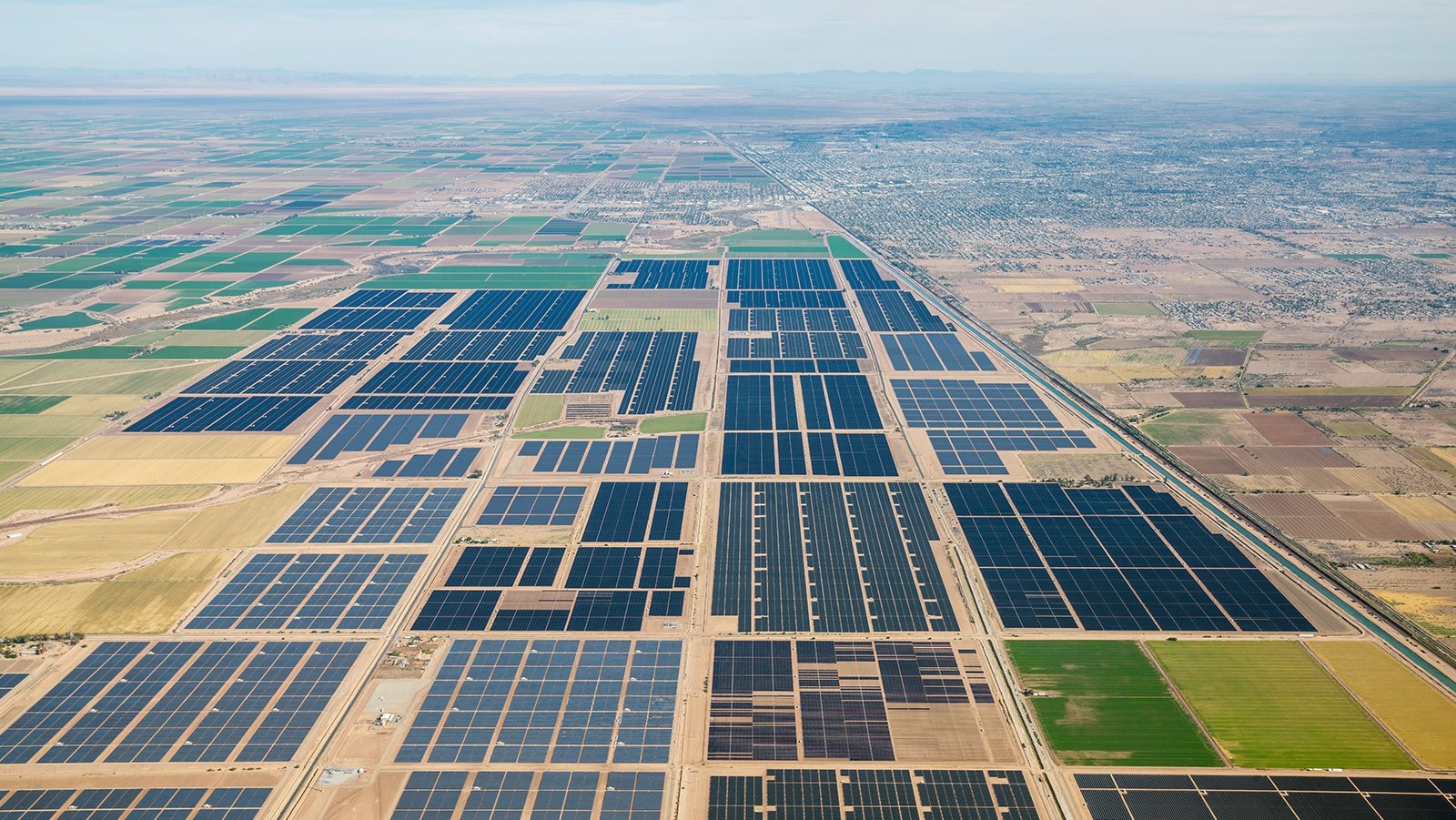
The U.S. solar industry has moved from being a relatively small renewable-energy segment to becoming one of the most important sources of new electricity-generation capacity in the country. Solar photovoltaic (PV) systems now operate across the United States, from residential rooftops and community-solar projects to utility-scale facilities covering thousands of acres.
The scale of that expansion is becoming increasingly visible in national electricity statistics. In 2025, U.S. solar electricity generation reached approximately 389 billion kilowatt-hours, with utility-scale photovoltaic plants accounting for about 76% of total solar generation and small-scale PV systems accounting for about 24%.
At the same time, the market is entering a more complicated phase. Solar deployment continues to grow rapidly, but developers face challenges involving grid interconnection, transmission capacity, project costs, supply chains, land use, electricity-market conditions, and changing federal and state policies.
For consumers, businesses, investors, utilities, and policymakers, the central question is no longer whether solar will play a major role in the American energy system. The more important question is how quickly the U.S. can integrate growing amounts of solar while maintaining a reliable, affordable electricity grid.
U.S. Solar Energy at a Glance
Several indicators demonstrate how quickly the American solar sector has expanded.
According to the U.S. Energy Information Administration (EIA), total U.S. solar electricity generation increased from only about 5 million kWh in 1984 to approximately 389 billion kWh in 2025. Solar’s contribution now includes both utility-scale facilities and smaller systems installed on homes, businesses, and other buildings.


U.S. photovoltaic capacity has also expanded dramatically. EIA data show total estimated solar PV capacity rising from approximately 33 GW in 2016 to more than 209 GW by the end of 2025, including utility-scale and small-scale systems.
The expansion is continuing in 2026. EIA reported that developers planned approximately 86 GW of new utility-scale generating capacity for the U.S. grid during 2026. Solar represented 51% of those planned additions, ahead of battery storage at 28% and wind at 14%.
These numbers illustrate a fundamental change in the American electricity market: solar is no longer simply an alternative energy technology. It has become a major source of new generation capacity.
Solar Is Becoming a Major Source of U.S. Electricity
The growth of solar is particularly significant because electricity demand in the United States is rising.
EIA expects total U.S. electricity generation to grow by 1.1% in 2026 and another 2.6% in 2027. At the same time, the agency expects the combined share of U.S. electricity generation from solar and wind to increase from approximately 18% in 2025 to about 21% in 2027.
Utility-scale solar is expected to be one of the fastest-growing sources of electricity generation.
EIA’s January 2026 forecast projected utility-scale solar generation to increase from approximately 290 billion kWh in 2025 to 424 billion kWh in 2027.
This growth matters because the U.S. power system is entering a period of increasing electricity demand. Data centers, manufacturing facilities, building electrification, electric vehicles, and other electricity-intensive activities are contributing to demand growth.
Solar can provide a significant portion of the additional generation required, particularly during periods of strong daytime electricity demand.
Where Is Solar Growing in the United States?
Solar resources vary significantly across the country. The Southwest generally receives the strongest solar radiation, but solar PV can operate effectively across a much broader geographic area.
According to EIA, latitude, climate, weather patterns, and the amount of solar radiation received at a location all influence solar-system performance.
The distribution of solar generation is therefore not uniform.
In 2025, Texas accounted for about 20% of U.S. utility-scale solar electricity generation, followed by California at approximately 18%. California remained particularly important for distributed solar, accounting for nearly 37% of U.S. small-scale PV generation.
Texas is becoming especially important because of its enormous electricity market, available land, strong solar resources, and rapid expansion of generation capacity.
EIA has projected that solar generation could exceed coal generation on the ERCOT grid in 2026, highlighting the speed at which the state’s electricity mix is changing.
Utility-Scale Solar vs. Rooftop Solar
The American solar market consists of several distinct segments.
Utility-scale solar
Utility-scale solar projects are large power plants that supply electricity to the grid. They can range from relatively modest projects to facilities with hundreds of megawatts of generating capacity.
These projects are particularly important to overall U.S. solar growth because they can be deployed at a scale capable of supplying electricity to large numbers of customers.
EIA reported that utility-scale PV accounted for approximately 76% of U.S. solar electricity generation in 2025.
Residential and small-scale solar
Small-scale PV includes systems below 1 MW, many of which are installed on residential and commercial buildings.
Residential solar has become an important component of the U.S. energy transition because it allows customers to generate electricity at or near the point where it is consumed.
EIA estimates that residential systems accounted for approximately 68% of small-scale PV electricity generation in 2025.
The combination of utility-scale and distributed solar creates a more diverse electricity-generation landscape, but it also introduces different challenges related to grid management, interconnection, transmission, and electricity pricing.
The Rise of Solar Plus Battery Storage
One of the biggest developments in the U.S. energy market is the growing relationship between solar power and battery storage.
Solar generation naturally varies throughout the day. Output generally increases after sunrise, reaches its highest levels around the middle of the day, and declines as the sun sets.
Battery storage can help address this mismatch by storing electricity when solar production is high and making that energy available later.
This is becoming increasingly important as solar penetration rises.
The Department of Energy’s National Laboratory of the Rockies reported that the United States added approximately 21.7 GWh of energy storage onto the electric grid during the first half of 2025, equivalent to about 7.7 GW of power capacity.
The combination of solar and batteries can provide several grid benefits:
-
Shifting solar electricity into evening hours
-
Reducing periods of excess solar generation
-
Supporting grid flexibility
-
Providing capacity during periods of high demand
-
Improving the economic value of solar projects
-
Helping integrate larger quantities of variable renewable generation
As solar deployment grows, energy storage is likely to become an increasingly important part of the U.S. electricity system.
Solar Costs and the Economics of Deployment
The economics of solar have improved dramatically over the past several decades, although actual project costs vary considerably depending on system size, location, financing, equipment, labor, permitting, and grid-connection requirements.
The Department of Energy’s 2025 Solar Industry Update reported modeled and reported U.S. PV system-price ranges during the first half of 2025 of approximately:
-
$3.2–$4.2 per watt for residential solar
-
$2.0–$3.6 per watt for nonresidential solar
-
Approximately $1.10 per watt for utility-scale solar
These figures represent different market segments and methodologies and should not be interpreted as a universal installation price.
For homeowners, the economic calculation also depends on electricity rates, system output, financing costs, incentives, net-metering or other compensation arrangements, and local regulations.
The U.S. National Renewable Energy Laboratory provides the PVWatts Calculator, which can estimate the expected electricity production of a grid-connected PV system based on location and system characteristics.
The U.S. Solar Manufacturing Industry Is Expanding
Solar deployment is only one part of the industry’s development. The United States is also attempting to strengthen domestic solar manufacturing.
According to the Department of Energy’s Solar Industry Update, U.S. manufacturers produced approximately 15.7 GWdc of PV modules during the first half of 2025, representing a 126% increase compared with the same period a year earlier. Domestic manufacturing has become strategically important because the solar industry depends on a complex international supply chain involving polysilicon, wafers, cells, modules, inverters, trackers, and other components.
Trade policies and tariffs have also affected the U.S. solar market. These policies can influence module prices, project economics, sourcing decisions, and the pace at which new manufacturing facilities are built.
The result is a U.S. solar market that is simultaneously expanding deployment while attempting to develop a stronger domestic manufacturing base.
Solar’s Impact on the U.S. Electricity Grid
Rapid solar growth creates both opportunities and challenges for the American grid.
Solar generation is variable. Electricity production depends on sunlight, weather, season, time of day, and system location. EIA describes solar energy as an intermittent resource whose availability varies according to these factors.
As the percentage of solar generation increases, grid operators must manage periods when solar output is extremely high as well as periods when production falls rapidly.
This can create several challenges:
Transmission constraints
Many of the best locations for large solar projects are far from major electricity-demand centers. Moving that electricity requires transmission infrastructure.
Interconnection delays
Solar developers must connect new projects to existing electricity networks. In areas where the grid is already congested, interconnection can become a major bottleneck.
Solar curtailment
When electricity supply exceeds what the grid can absorb economically or technically, operators may reduce renewable generation. Greater storage, transmission, flexible demand, and improved market design can help reduce this problem.
Evening demand
Solar production declines around sunset, while electricity demand can remain high. Batteries and other flexible resources can help bridge this gap.
These challenges do not mean that solar cannot continue growing. Rather, they mean that solar expansion increasingly needs to be accompanied by investments in transmission, storage, grid modernization, forecasting, and flexible electricity demand.
Solar Energy and American Jobs
Solar’s growth has also created a substantial employment ecosystem involving installation, project development, engineering, manufacturing, operations, maintenance, finance, construction, and research.
The Department of Energy’s 2025 Solar Industry Update reported that more than 280,000 U.S. employees spent most of their working time on solar project or manufacturing activities in 2024. It also reported approximately 79,000 jobs associated with battery energy-storage systems.
This means the solar industry is becoming increasingly connected to the broader American industrial economy.
Solar projects require construction workers, electricians, engineers, equipment manufacturers, land-management specialists, financiers, software developers, and operations personnel.
Community Solar Expands Access Beyond Homeowners
Not every American household has a suitable roof for solar.
A home may have too much shade, an unsuitable roof orientation, structural limitations, or other constraints. Renters also generally cannot install their own rooftop system.
Community solar offers another model.
In a community-solar arrangement, multiple customers can subscribe to electricity produced by a shared solar facility and receive financial benefits through their utility arrangements.
However, this market is facing its own challenges. The Solar Energy Industries Association and Wood Mackenzie reported that U.S. community-solar installations declined year over year in the first quarter of 2025, while lengthy interconnection processes continued to constrain development.
Community solar therefore represents an important opportunity, but its future depends heavily on state policies, utility programs, interconnection capacity, and project economics.
Solar and Agriculture: A Growing Area of Interest
Solar development does not necessarily have to compete directly with agricultural activity.
Researchers and developers are exploring agrivoltaics, in which solar panels and agricultural production coexist on the same land.
Projects can involve growing crops beneath or between panels, grazing livestock around solar installations, or designing solar systems specifically to support agricultural operations.
The Department of Energy’s InSPIRE research program has studied the environmental compatibility and potential benefits of combining solar installations with agriculture and native landscapes.
This field could become increasingly important as the United States searches for ways to expand renewable electricity while managing land-use concerns.
What Is the Outlook for U.S. Solar Energy?
The near-term outlook remains strongly positive in terms of deployment.
EIA’s January 2026 forecast identified utility-scale solar as the fastest-growing source of U.S. electricity generation, projecting generation to rise from approximately 290 billion kWh in 2025 to 424 billion kWh in 2027.
EIA also reported that developers planned approximately 86 GW of new utility-scale generating capacity for 2026, with solar accounting for more than half of those planned additions.
But the future of U.S. solar will depend on more than installing additional panels.
The industry will increasingly need to solve five interconnected problems:
-
Grid capacity — building enough transmission and distribution infrastructure.
-
Energy storage — shifting solar electricity to periods when it is most valuable.
-
Interconnection — reducing the time and cost required to connect new projects. while the country is simultaneously adding large quantities of renewable generation and energy storage. Solar is positioned at the center of this transformation because it can be deployed at multiple scales—from individual homes
-
Manufacturing and supply chains — developing resilient domestic and international sources of equipment.
-
Market and policy stability — creating investment conditions that allow developers and manufacturers to plan over many years.
The Bigger Picture: Solar’s Role in America’s Energy Future
The U.S. energy system is entering a period of structural change.
Electricity demand is expected to increase, while the country is simultaneously adding large quantities of renewable generation and energy storage. Solar is positioned at the center of this transformation because it can be deployed at multiple scales—from individual homes to enormous utility-scale power plants.
The industry’s next phase will therefore be less about proving that solar technology works and more about integrating solar into a much larger and more sophisticated electricity system.
That means pairing solar with batteries, expanding transmission, improving grid operations, modernizing electricity markets, strengthening domestic manufacturing, and developing projects that use land efficiently.
For American consumers, businesses, utilities, and investors, solar energy is becoming an increasingly important part of the country’s electricity future.
The numbers already demonstrate the direction of travel: U.S. solar generation reached roughly 389 billion kWh in 2025, total PV capacity surpassed 209 GW, and solar represented more than half of planned utility-scale generating capacity additions for 2026.
The next chapter of American solar will not simply be about building more panels. It will be about building the infrastructure, storage, manufacturing capacity, and grid flexibility required to turn abundant sunlight into reliable electricity at national scale.

Seraphina Vale is a passionate content writer and blogger with 3 years of blogging experience, specializing in creating engaging, well-researched, and reader-focused articles. She enjoys breaking down complex topics into clear, practical insights that help readers stay informed and make confident decisions.