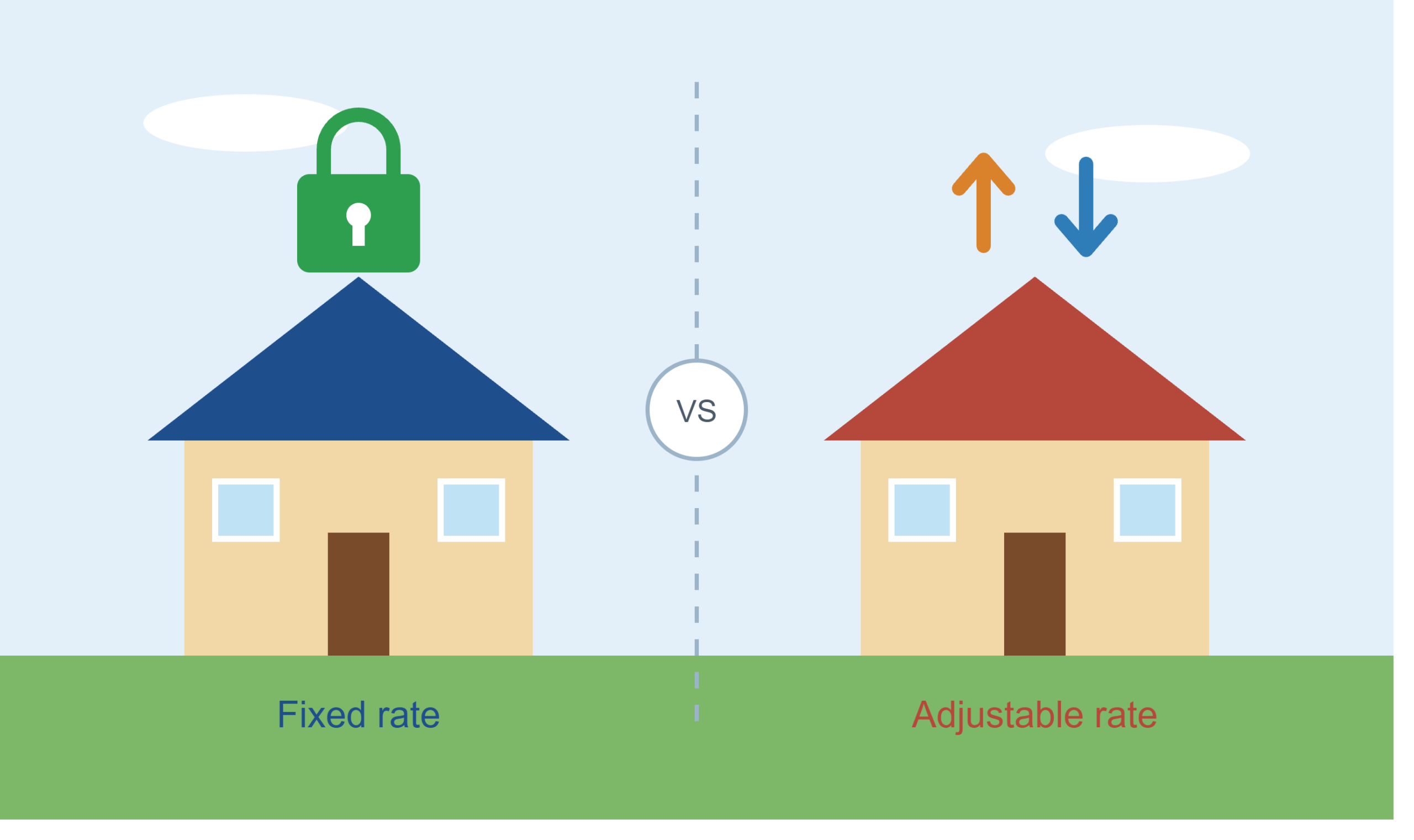
Choosing the right mortgage is one of the most important financial decisions a homebuyer makes in the United States. The type of interest rate attached to your mortgage can affect your monthly payment, long-term housing costs, financial flexibility, and the amount of interest you ultimately pay over the life of the loan.
Two of the most common mortgage structures are fixed-rate mortgages and adjustable-rate mortgages (ARMs). A fixed-rate mortgage provides a predictable interest rate for the entire loan term, while an adjustable-rate mortgage typically begins with a fixed introductory rate and later adjusts according to market conditions and the terms of the loan.
For many homebuyers, the fixed-rate mortgage is the simpler and more predictable option. However, an ARM can make sense in certain circumstances, particularly for borrowers who expect to move before the adjustable period begins or who are comfortable managing the possibility of higher future payments.
The important question is not simply whether fixed or adjustable mortgages are “better.” The better mortgage depends on your financial situation, how long you expect to own the property, your tolerance for risk, your income stability, and your ability to handle higher payments in the future.
The Consumer Financial Protection Bureau (CFPB) explains that fixed-rate mortgages generally offer greater payment predictability, while ARMs may begin with lower rates but can change later.
This guide explains the differences between fixed-rate and adjustable-rate mortgages, how each works, their advantages and disadvantages, when each option may make sense, and how U.S. homebuyers can compare the two before choosing a loan.
What Is a Fixed-Rate Mortgage?
A fixed-rate mortgage is a home loan where the interest rate is established when you take out the mortgage and generally remains unchanged throughout the loan term.
For example, suppose you purchase a home with a 30-year fixed-rate mortgage at a 6.25% interest rate. The interest rate on the mortgage does not change simply because market interest rates later rise or fall.
The principal-and-interest portion of your monthly payment is therefore predictable throughout the loan.
However, it is important to understand that your total monthly mortgage payment can still change in some circumstances. If your payment includes an escrow account, changes in property taxes, homeowners insurance, or certain other costs can cause the total payment to rise or fall.
The fixed interest rate itself, however, remains unchanged.
How a Fixed-Rate Mortgage Works
A fixed-rate mortgage generally consists of:
- Principal
- Interest
- Property taxes, if included through escrow
- Homeowners insurance, if included through escrow
- Mortgage insurance, when applicable
The principal and interest portion is determined by your loan amount, interest rate, and repayment term.
With a typical amortizing mortgage, your monthly payment gradually shifts from being more interest-heavy toward paying down more principal as the loan matures.
Common Fixed-Rate Mortgage Terms
Common fixed-rate mortgage terms in the United States include:
- 30-year fixed
- 20-year fixed
- 15-year fixed
- 10-year fixed
The 30-year fixed mortgage is particularly popular because it generally offers lower monthly principal-and-interest payments than a shorter-term mortgage.
A 15-year mortgage generally has higher monthly payments but can substantially reduce the total interest paid over the life of the loan.
What Is an Adjustable-Rate Mortgage?
An adjustable-rate mortgage (ARM) is a mortgage in which the interest rate can change after an initial fixed-rate period.
An ARM may begin with a lower interest rate than a comparable fixed-rate mortgage. However, after the introductory period ends, the rate can adjust according to the loan’s terms.
The adjustment is generally tied to an index plus a lender-established margin, subject to applicable rate caps.
For example, a mortgage advertised as a 5/1 ARM generally means:
- The initial rate is fixed for five years.
- After those five years, the rate can adjust.
- The “1” generally indicates annual adjustments after the initial fixed period.
Other ARM structures may have different initial fixed periods and adjustment schedules.
How an ARM Works
An ARM typically has two major phases.
The first phase is the initial fixed-rate period. During this period, the interest rate does not change.
The second phase begins when the introductory period ends. The interest rate can then adjust according to the loan’s index, margin, adjustment frequency, and caps.
This means the monthly principal-and-interest payment can increase or decrease over time.
Fixed-Rate vs. Adjustable-Rate Mortgage: Quick Comparison
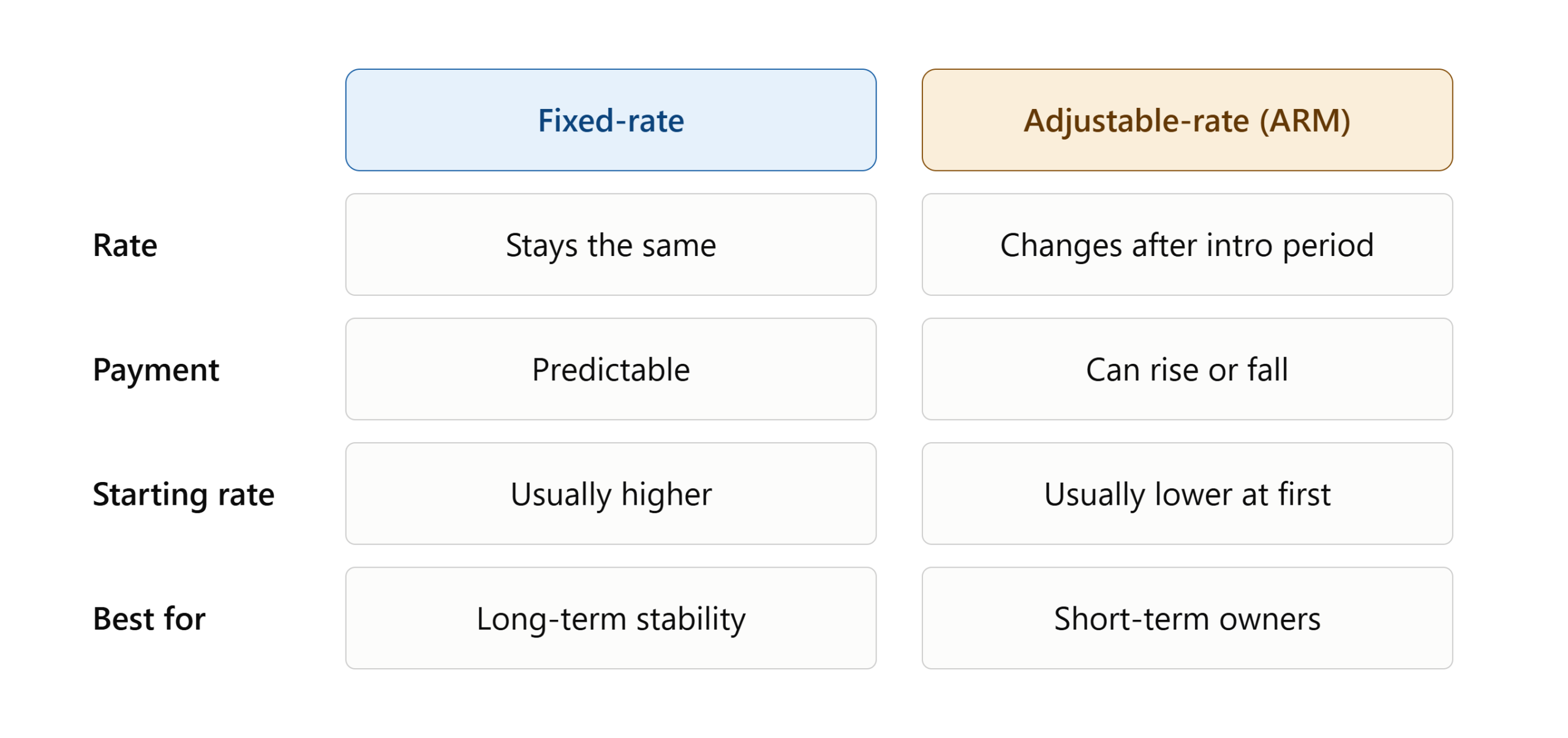
| Feature | Fixed-Rate Mortgage | Adjustable-Rate Mortgage |
|---|---|---|
| Initial interest rate | Fixed | Usually fixed initially |
| Rate after introductory period | Does not change | Can change |
| Monthly principal & interest | Predictable | Can increase or decrease |
| Long-term certainty | High | Lower |
| Initial payment | May be higher | Often lower |
| Future payment risk | Low | Higher |
| Best for | Long-term stability | Certain short- or medium-term strategies |
| Exposure to market rates | Low | Higher |
| Complexity | Generally simpler | More complicated |
| Refinancing required to change rate | Usually | Rate can change automatically |
The CFPB describes fixed-rate mortgages as lower-risk and more predictable, while ARMs can offer lower initial costs but carry greater uncertainty.
The Biggest Difference Between Fixed and Adjustable Mortgages
The biggest difference is who takes the interest-rate risk.
With a fixed-rate mortgage, the borrower receives protection from future increases in market interest rates. If mortgage rates rise after closing, your contractual fixed interest rate does not automatically rise.
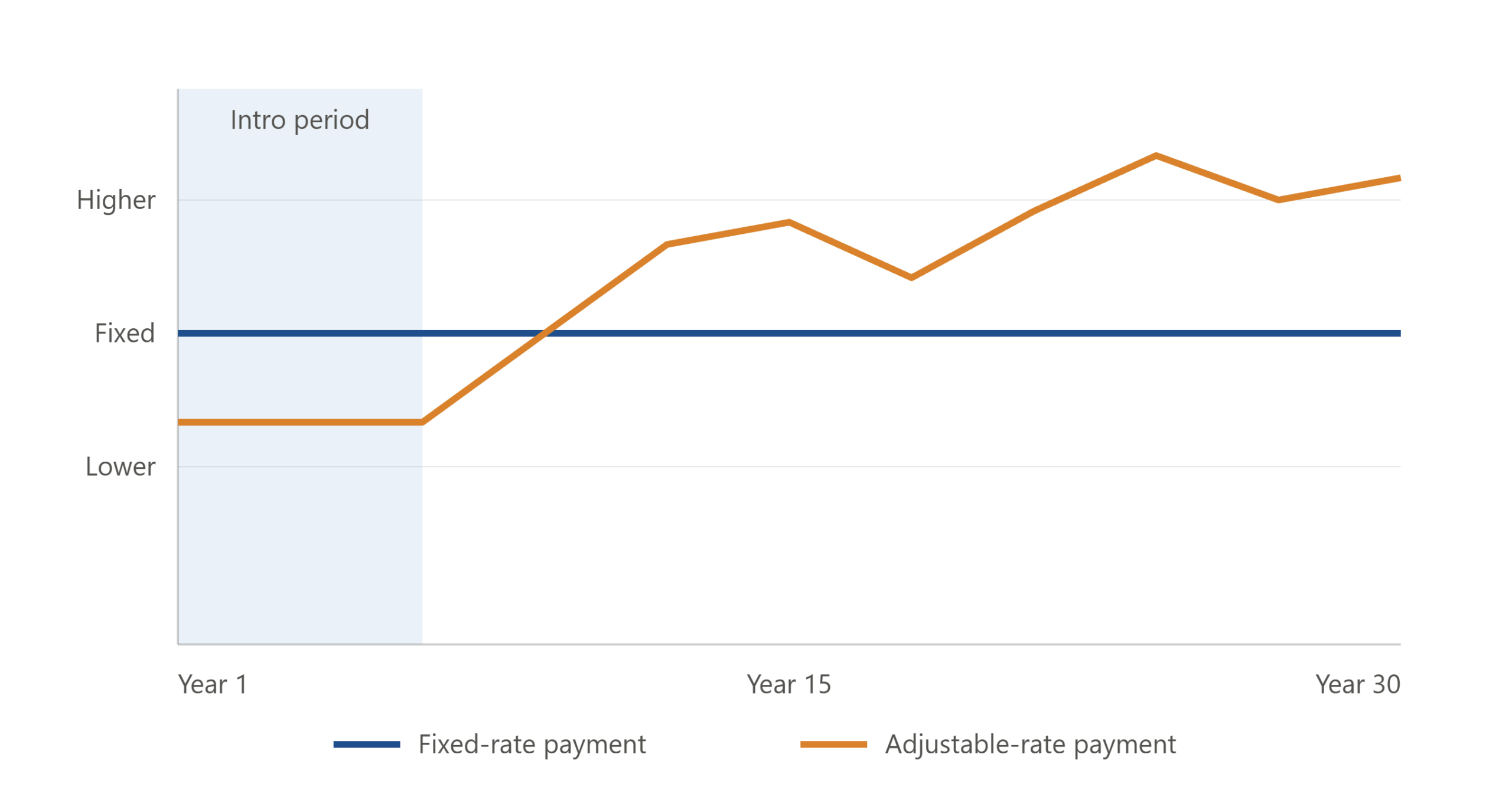
With an ARM, the borrower accepts some future interest-rate risk in exchange for the possibility of a lower initial rate.
If market rates rise, the ARM’s rate and payment may rise.
If market rates fall, the rate may decrease depending on the ARM’s specific terms.
That tradeoff is the central issue when deciding between these mortgage types.
Advantages of a Fixed-Rate Mortgage
Predictable Mortgage Payments
One of the biggest benefits is predictability.
You generally know what your principal-and-interest payment will be throughout the loan term.
This makes budgeting easier, particularly for households that prefer stable monthly expenses.
Protection From Rising Interest Rates
A fixed-rate mortgage protects you from increases in market mortgage rates.
For example, if you lock in a fixed rate and mortgage rates later increase substantially, your mortgage’s interest rate does not automatically rise.
Easier Long-Term Planning
Fixed-rate mortgages can be particularly attractive if you expect to remain in the home for many years.
You can plan your household budget without worrying about an upcoming ARM adjustment.
Simpler to Understand
Fixed-rate mortgages are generally easier for borrowers to understand.
You don’t have to continuously monitor an index, margin, adjustment schedule, or future rate caps to determine how the interest rate might change.
Useful for Risk-Averse Borrowers
Homebuyers who strongly value financial stability may prefer a fixed-rate mortgage even if the initial rate is somewhat higher than an ARM.
The additional cost can effectively purchase greater payment certainty.
Disadvantages of a Fixed-Rate Mortgage
Potentially Higher Initial Rate
One of the major disadvantages is that a fixed-rate mortgage can have a higher initial interest rate than an ARM.
This may result in a higher initial principal-and-interest payment.
Less Benefit if Rates Fall
If market mortgage rates decline substantially, your fixed mortgage rate does not automatically fall.
You would generally need to refinance to take advantage of lower rates, and refinancing involves costs and qualification requirements.
Potentially Higher Short-Term Cost
If you know you will sell the home relatively soon, paying for long-term rate stability may not always be the most cost-efficient strategy.
The appropriate choice depends on the rate difference, closing costs, expected ownership period, and your financial circumstances.
Advantages of an Adjustable-Rate Mortgage
Lower Initial Interest Rate
One of the main attractions of an ARM is its potentially lower initial interest rate.
The introductory rate can make the initial mortgage payment lower than that of a comparable fixed-rate loan.
Lower Initial Monthly Payment
A lower initial interest rate generally means a lower principal-and-interest payment during the introductory period.
This can provide additional cash flow during the first several years of homeownership.
Potential Savings for Short-Term Homeowners
An ARM can make sense for some borrowers who reasonably expect to sell their home before the adjustable period begins.
For example, someone purchasing a home because of a temporary job assignment might expect to own the property for only a few years.
However, borrowers should not assume that they will definitely be able to sell or refinance before the rate adjusts. The CFPB specifically warns against relying on a future sale or refinance as the only strategy for handling ARM risk.
Potential Benefit if Interest Rates Decline
If market conditions result in a lower applicable ARM rate after an adjustment, the borrower’s rate and payment may decrease, depending on the loan terms.
However, borrowers should never assume that rates will fall.
Disadvantages of an Adjustable-Rate Mortgage
Future Payments Can Increase
The most important risk is payment uncertainty.
After the initial fixed period, the interest rate may rise, potentially causing a significant increase in the monthly payment.
More Complicated Loan Structure
ARMs require borrowers to understand several components, including:
- Initial fixed period
- Adjustment frequency
- Index
- Margin
- Initial adjustment cap
- Subsequent adjustment cap
- Lifetime cap
- Rate floor
- Payment recalculation
The CFPB recommends carefully reviewing these terms before choosing an ARM.
Interest-Rate Risk
If market interest rates increase, your mortgage rate may increase at the next adjustment.
This can make long-term budgeting more difficult.
Refinancing Is Not Guaranteed
Some borrowers choose an ARM believing they will refinance into a fixed-rate mortgage before the ARM adjusts.
That strategy carries risk.
You may not qualify for refinancing later. Your home’s value could fall, your financial situation could change, or refinancing costs could make the transaction unattractive.
The CFPB advises borrowers not to assume that refinancing will always be available.
What Is a 5/1 ARM?
A 5/1 ARM is one of the better-known ARM structures.
The “5” generally means the initial interest rate remains fixed for five years.
The “1” generally means the rate can adjust once every year after that initial period.
For example:
Years 1–5: Initial fixed rate
Year 6: First potential adjustment
Year 7: Second potential adjustment
Year 8: Third potential adjustment
And so on, according to the loan agreement.
The exact terms should always be verified in the loan documents because ARM structures can vary.
What Is a 7/1 ARM?
A 7/1 ARM generally has a seven-year initial fixed-rate period followed by potential annual adjustments.
This can provide more initial payment stability than a 5/1 ARM.
A borrower who expects to move within seven years may find this structure worth considering, provided the initial rate and other loan terms are competitive.
However, a longer initial fixed period does not eliminate the risk of future adjustments if the borrower keeps the loan beyond that period.
What Is a 10/1 ARM?
A 10/1 ARM generally provides a 10-year initial fixed-rate period before annual adjustments begin.
This gives borrowers more time before potential rate changes than shorter introductory ARM structures.
However, the tradeoff is that borrowers should still evaluate what happens if they remain in the home beyond the initial fixed period.
Understanding ARM Index and Margin
The index and margin are two critical components of an adjustable-rate mortgage.
The index is a market-based interest-rate measure that changes over time.
The margin is a number of percentage points established by the lender and included in the loan agreement.
After the introductory rate expires, the fully indexed rate is generally calculated using:
Index + Margin = Fully Indexed Interest Rate
The resulting rate is subject to the ARM’s applicable caps and other contractual terms.
Why the Margin Matters
Two lenders could potentially offer similar initial ARM rates but different margins.
Because the margin can influence future adjustments, borrowers should not compare ARMs solely by looking at the introductory rate.
A lower initial rate does not necessarily mean the loan is the best long-term deal.
Understanding ARM Rate Caps
Rate caps limit how much an ARM’s interest rate can change.
The CFPB identifies three major types of ARM caps:
Initial Adjustment Cap
This limits how much the rate can change during the first adjustment.
Subsequent Adjustment Cap
This limits how much the rate can change during later adjustment periods.
Lifetime Adjustment Cap
This limits how much the rate can increase or decrease over the life of the loan relative to the initial rate, according to the loan’s terms.
These caps can vary between mortgage products, so borrowers should compare them carefully.
Example: How an ARM Payment Could Change
Consider a hypothetical $400,000 mortgage.
Suppose the borrower receives:
- 5/1 ARM
- Initial rate: 5.50%
- 30-year repayment term
The initial principal-and-interest payment would be approximately $2,271 per month.
If the rate later increases to 7.50%, the principal-and-interest payment on the remaining balance could become substantially higher.
The exact payment after an adjustment depends on the remaining principal balance, remaining term, new interest rate, and the specific loan’s recalculation rules.
This illustrates why borrowers should evaluate an ARM based not only on its introductory payment but also on possible future payments.
Fixed-Rate vs. ARM: Which Is Better for First-Time Homebuyers?
For many first-time buyers, a fixed-rate mortgage can be easier to manage because it provides greater payment predictability.
First-time buyers may already be dealing with expenses such as:
- Down payment
- Closing costs
- Moving expenses
- Furniture
- Repairs
- Property taxes
- Homeowners insurance
- Maintenance
Adding uncertainty to the mortgage payment may not be desirable for someone with a limited financial cushion.
However, an ARM can still be appropriate for a first-time buyer if the borrower fully understands the risks, has sufficient financial reserves, and has a strong reason for choosing the adjustable structure.
The key is not whether someone is a first-time buyer but whether the borrower can comfortably handle the loan under less favorable future conditions.
Fixed-Rate vs. ARM for Long-Term Homeowners
If you expect to live in your home for 10, 15, 20, or 30 years, a fixed-rate mortgage may be particularly attractive.
The longer you expect to keep the mortgage, the more important long-term rate certainty can become.
A fixed-rate loan eliminates the need to predict where interest rates will be several years into the future.
That predictability can be valuable even if the initial fixed rate is higher than an ARM’s introductory rate.
Fixed-Rate vs. ARM for Short-Term Homeowners
An ARM may be worth considering if you expect to sell the property before the adjustable period begins.
For example, someone who expects to relocate for work within five years might consider a 5/1 ARM.
However, this strategy should not be treated as guaranteed.
Your plans could change.
The housing market could weaken.
Your home might take longer to sell.
You could experience a job or income change.
Your financial circumstances could prevent refinancing.
The CFPB recommends considering whether you could afford the higher payment if you end up keeping the property longer than expected.
Fixed-Rate vs. ARM for Investors and Real Estate Buyers
Real estate investors may evaluate ARMs differently from owner-occupants.
An investor might prioritize:
- Initial cash flow
- Expected holding period
- Property appreciation assumptions
- Rental income
- Financing costs
- Exit strategy
- Refinancing possibilities
An ARM could potentially reduce initial financing costs, but an investor must consider the effect of higher future payments on cash flow.
The same principle applies: the investment should remain financially viable even if the mortgage becomes more expensive.
What Happens If Interest Rates Fall?
With a fixed-rate mortgage, your interest rate generally remains unchanged when market rates fall.
If you want a lower rate, you may need to refinance.
With an ARM, the interest rate may adjust downward when the relevant index falls, depending on the loan’s terms and applicable caps or floors.
However, the payment does not necessarily fall every time market rates decline.
Borrowers should examine the exact loan agreement rather than assuming an ARM will automatically produce lower payments when rates fall.
What Happens If Interest Rates Rise?
This is where the difference becomes especially important.
With a fixed-rate mortgage, rising market interest rates do not automatically increase your contractual mortgage rate.
With an ARM, rising market rates can eventually result in a higher mortgage rate and higher payment after the introductory period, subject to the loan’s adjustment rules and caps.
Therefore, ARM borrowers need to consider their ability to afford the mortgage under higher-rate scenarios.
Should You Choose Fixed or Adjustable?
A fixed-rate mortgage may be a better fit if:
- You plan to stay in the home for many years.
- You prefer predictable payments.
- You have limited tolerance for financial risk.
- You want protection against rising interest rates.
- You want a simpler mortgage structure.
- You don’t want to depend on refinancing later.
An ARM may be worth considering if:
- You expect to sell before the adjustable period begins.
- The initial rate provides a meaningful financial advantage.
- You have sufficient financial reserves.
- You can afford a higher future payment.
- You understand the ARM’s index, margin, caps, and adjustment schedule.
- You have evaluated the loan under unfavorable interest-rate scenarios.
How to Compare a Fixed Mortgage and ARM
Don’t compare the loans based only on the advertised interest rate.
Instead, compare:
Initial Interest Rate
What rate will you actually receive?
APR
APR incorporates the interest rate plus certain loan charges and can provide additional information when comparing mortgage offers. However, the CFPB cautions that ARM APRs require special care because APR does not reflect the maximum possible ARM interest rate.
Monthly Payment
Compare the initial principal-and-interest payments.
Maximum Possible Payment
Ask the lender what your payment could become under the loan’s maximum permitted adjustment.
Adjustment Schedule
Determine when the ARM can first adjust and how frequently it can change afterward.
Index
Find out which index determines future adjustments.
Margin
Compare the lender’s margin.
Rate Caps
Review initial, subsequent, and lifetime caps.
Closing Costs
A lower interest rate is not necessarily a better deal if the loan carries substantially higher upfront costs.
Points
Determine whether you are paying points to reduce the interest rate.
Prepayment Terms
Check whether there are any applicable prepayment penalties.
The CFPB recommends comparing both the basic loan terms and the other costs and features that affect the overall mortgage price.
Don’t Compare Mortgages by Rate Alone
A common mistake is to see an ARM advertised at a lower rate and immediately assume it is cheaper.
For example:
Option A: 30-year fixed at 6.25%
Option B: 5/1 ARM at 5.50%
At first glance, the ARM appears cheaper.
But the ARM’s 5.50% rate may apply only during the introductory period.
Afterward, the rate could change.
Therefore, a meaningful comparison should consider:
- Initial payment
- Future payment scenarios
- Total interest
- Closing costs
- Points
- Expected ownership period
- Maximum possible rate
- Maximum possible payment
- Refinancing risk
Can You Switch From an ARM to a Fixed Mortgage?
An ARM does not automatically convert into a new fixed-rate mortgage simply because you want more certainty.
A borrower may potentially refinance an ARM into a fixed-rate mortgage if they qualify for refinancing and the transaction makes financial sense.
However, refinancing is not guaranteed.
The borrower must generally qualify based on the lender’s requirements, and refinancing involves costs.
This is why it is risky to choose an ARM solely because you assume you will refinance later.
Can You Switch From a Fixed Mortgage to an ARM?
Similarly, a borrower with a fixed-rate mortgage can potentially refinance into an ARM.
Whether this makes financial sense depends on current market rates, closing costs, expected time in the home, and the borrower’s financial objectives.
A refinance should be evaluated based on the total financial impact rather than simply the new interest rate.
Common Mistakes When Choosing an ARM
Focusing Only on the Initial Rate
The introductory rate is only one part of the mortgage.
Always investigate what happens after the initial period ends.
Assuming You Will Sell
Life circumstances can change.
You may decide to stay in the home longer than expected.
Assuming You Will Refinance
Future refinancing depends on your finances, home value, credit, market conditions, and lender requirements.
Ignoring the Maximum Payment
Ask the lender to show you the highest payment you could face under the loan terms.
Not Comparing Margins
A low introductory rate can distract borrowers from the ARM’s longer-term structure.
Not Reading the Loan Documents
ARM terms can be more complicated than fixed-rate mortgages.
Read the Loan Estimate, disclosures, and final loan documents carefully.
Forgetting Taxes and Insurance
Even with a fixed-rate mortgage, your total housing payment can change if property taxes or homeowners insurance change.
Questions to Ask Your Mortgage Lender
Before selecting an ARM, ask:
- What is the initial interest rate?
- How long is the initial fixed period?
- When can the rate first adjust?
- How often can the rate adjust?
- What index does the loan use?
- What is the margin?
- What is the initial adjustment cap?
- What is the subsequent adjustment cap?
- What is the lifetime cap?
- Is there a rate floor?
- How is the monthly payment recalculated?
- What is the maximum possible payment?
- Are there prepayment penalties?
- What are the closing costs?
- How much are the points?
- What would happen if rates rise significantly?
- What would happen if I keep the loan longer than expected?
These questions can help you understand the actual financial risk rather than focusing only on the advertised starting rate.
How Your Personal Financial Situation Should Influence the Decision
There is no universally correct mortgage type.
Consider your:
Income Stability
If your income is highly predictable, you may have more capacity to plan for a mortgage payment.
If your income fluctuates significantly, payment uncertainty may be more difficult to manage.
Emergency Savings
A borrower with substantial emergency reserves may have more flexibility to absorb higher payments.
Debt-to-Income Ratio
A high debt-to-income ratio can make a payment increase more difficult to handle.
Expected Time in the Home
Your expected ownership period is one of the most important factors.
Risk Tolerance
Some homeowners strongly prefer certainty even when it costs more initially.
Others may accept additional risk in exchange for potentially lower initial payments.
Fixed-Rate Mortgage vs. ARM: A Simple Decision Framework
Ask yourself five questions.
Question 1: How long will I probably own the home?
If the answer is decades, fixed-rate financing may provide valuable stability.
If you expect to move relatively soon, an ARM may deserve consideration.
Question 2: Can I afford a substantially higher payment?
If the answer is no, a fixed-rate mortgage may be safer.
Question 3: Do I have significant emergency savings?
A strong cash reserve can provide more flexibility if expenses rise.
Question 4: Am I relying on refinancing?
If your entire strategy depends on refinancing, reconsider.
Question 5: Do I understand the ARM completely?
If you cannot explain the adjustment schedule, index, margin, caps, and maximum payment, you may not yet have enough information to choose the ARM confidently.
Is a Fixed-Rate Mortgage Always Better?
No.
Fixed-rate mortgages provide important benefits, but that does not mean they are always the cheapest option for every borrower.
A homeowner who sells before an ARM adjustment may benefit from the ARM’s lower initial rate.
Similarly, someone with a strong financial position and a clear short-term ownership strategy may be comfortable accepting ARM risk.
The right question is:
Which mortgage structure fits your expected ownership period and ability to manage financial risk?
Is an ARM Always Risky?
An ARM carries more payment uncertainty than a fixed-rate mortgage, but modern ARMs generally include contractual limits on how much rates can change.
Federal consumer protections and mortgage underwriting rules also apply to many mortgage products.
Fannie Mae’s standard conventional ARM requirements, for example, include limits on interest-rate changes.
Nevertheless, an ARM still requires careful evaluation.
The existence of rate caps does not mean payments cannot rise significantly.
Fixed-Rate vs. ARM: Which Is Better in 2026?
There is no single mortgage type that is best for every U.S. homebuyer in 2026.
For borrowers prioritizing long-term stability and predictable principal-and-interest payments, a fixed-rate mortgage remains an attractive option.
For borrowers who have a shorter expected ownership period, strong financial reserves, and a clear understanding of ARM mechanics, an adjustable-rate mortgage may provide an opportunity to reduce initial borrowing costs.
The best decision should be based on the actual loan offers available to you rather than general assumptions about future interest rates.
Compare multiple lenders and review the Loan Estimate carefully before making a final decision. The CFPB recommends comparing loan terms, payments, costs, and other features rather than looking at a single advertised rate.
Frequently Asked Questions
Is a fixed-rate mortgage safer than an ARM?
Generally, a fixed-rate mortgage provides greater payment predictability because the interest rate does not adjust with market conditions. An ARM exposes the borrower to the possibility of future rate and payment changes.
Is an ARM cheaper than a fixed mortgage?
An ARM may have a lower initial interest rate and payment, but that does not guarantee a lower total cost over the life of the mortgage.
What happens when an ARM expires?
The initial fixed-rate period does not mean the entire mortgage expires. Instead, the loan generally enters its adjustable period, during which the interest rate may change according to the loan’s terms.
What is a 5/1 ARM?
A 5/1 ARM generally has a fixed interest rate for five years, followed by potential annual rate adjustments.
What is a 7/1 ARM?
A 7/1 ARM generally has a seven-year initial fixed period followed by potential annual adjustments.
Can an ARM payment go down?
Yes. Depending on the loan’s terms and market conditions, the interest rate and payment may decrease. However, caps, floors, and other contractual provisions can affect how much the rate can change.
Can an ARM payment double?
The exact maximum depends on the loan’s terms, including its rate caps, remaining balance, repayment period, and other features. Borrowers should ask the lender to calculate the maximum possible payment before accepting the loan.
Should first-time buyers choose a fixed-rate mortgage?
Many first-time buyers may appreciate the predictability of a fixed-rate mortgage, but an ARM can also be appropriate in certain situations. The decision should be based on the buyer’s finances, expected ownership period, and ability to handle future payment changes.
Should I choose a 30-year fixed or 5/1 ARM?
Neither is automatically better.
A 30-year fixed may be preferable for long-term stability, while a 5/1 ARM may appeal to someone who expects to sell or otherwise no longer hold the mortgage before the adjustable period becomes relevant.
Should I choose an ARM if I plan to refinance?
Be careful.
Refinancing can be useful, but you should not assume you will qualify for a refinance in the future. Your financial circumstances, home value, credit profile, market conditions, and lender requirements can change.
How do I know which mortgage is right for me?
Compare the initial rate, APR, monthly payment, loan costs, expected ownership period, ARM adjustment terms, rate caps, and maximum potential payment. Then consider whether your income and savings could withstand an unfavorable scenario.
Final Thoughts
The choice between a fixed-rate mortgage and an adjustable-rate mortgage ultimately comes down to the balance between certainty and potential short-term savings.
A fixed-rate mortgage provides greater predictability. Your contractual interest rate remains stable, making it easier to budget and protect yourself from rising market rates.
An adjustable-rate mortgage can provide a lower initial rate and potentially lower early payments, but it transfers more interest-rate risk to the borrower. Once the introductory period ends, the rate may adjust based on the loan’s terms and market conditions.
For long-term homeowners who value stability, a fixed-rate mortgage is often the easier option to manage.
For borrowers with shorter expected ownership periods, strong finances, and a clear understanding of ARM terms, an adjustable-rate mortgage may deserve consideration.
Before choosing either option, compare multiple mortgage offers and carefully review the Loan Estimate. Pay attention not just to the initial interest rate, but also to fees, APR, payment changes, ARM caps, adjustment periods, and the maximum payment you could face.
The best mortgage is not necessarily the one with the lowest advertised rate. It is the one that fits your financial situation, your expected time in the home, and your ability to handle the loan under both favorable and unfavorable conditions.

Seraphina Vale is a passionate content writer and blogger with 3 years of blogging experience, specializing in creating engaging, well-researched, and reader-focused articles. She enjoys breaking down complex topics into clear, practical insights that help readers stay informed and make confident decisions.