I remember the exact moment a friend called me, voice bright with relief and excitement. She had just received the email she had been waiting for—the formal job offer. The salary matched what they had discussed, the start date worked, and the benefits summary looked solid. “This is it,” she said. “I’m set.”
A week later she called again, this time sounding less certain. HR had sent a longer document to sign before her first day. “I thought the offer letter was the agreement,” she said. “Now there’s this multi-page contract and I’m not sure what I already agreed to or what still matters.”
That confusion is extremely common. Many people treat the offer letter as the final word and then feel caught off guard when a more detailed employment contract arrives—or when no formal contract ever appears and they realize they are working under much thinner protections than they assumed. Understanding the difference between these two documents can save you from unwelcome surprises and help you negotiate from a clearer position.
This guide explains what each document usually is, how the law tends to treat them, what to look for in both, and how to protect yourself whether you receive one, the other, or both. It is written for employees and job candidates in everyday language. It is not legal advice—employment laws vary by state and individual situations differ—so when the stakes are high, speaking with an employment attorney remains the wisest step.

What an Offer Letter Usually Is
An offer letter is typically a shorter document that confirms the basic terms of a job offer. Employers use it to formalize the conversation that happened during interviews and to give the candidate something concrete to accept.
Most offer letters include:
- Job title
- Start date
- Reporting structure or department
- Base salary or hourly rate
- A high-level summary of benefits
- Any signing bonus or relocation assistance
- A statement that employment is at-will
- Instructions for accepting the offer
Some offer letters are warm and concise—one or two pages. Others run longer and begin to look more detailed. The tone is usually positive and forward-looking. The purpose is to secure the candidate’s commitment and set initial expectations.
Importantly, many offer letters explicitly state that they are not a binding employment contract and that the company can change terms or end the relationship at will. Even without that language, courts in most states often treat a typical offer letter as an invitation to begin an at-will relationship rather than a guarantee of fixed terms for a set period.
What an Employment Contract Usually Is
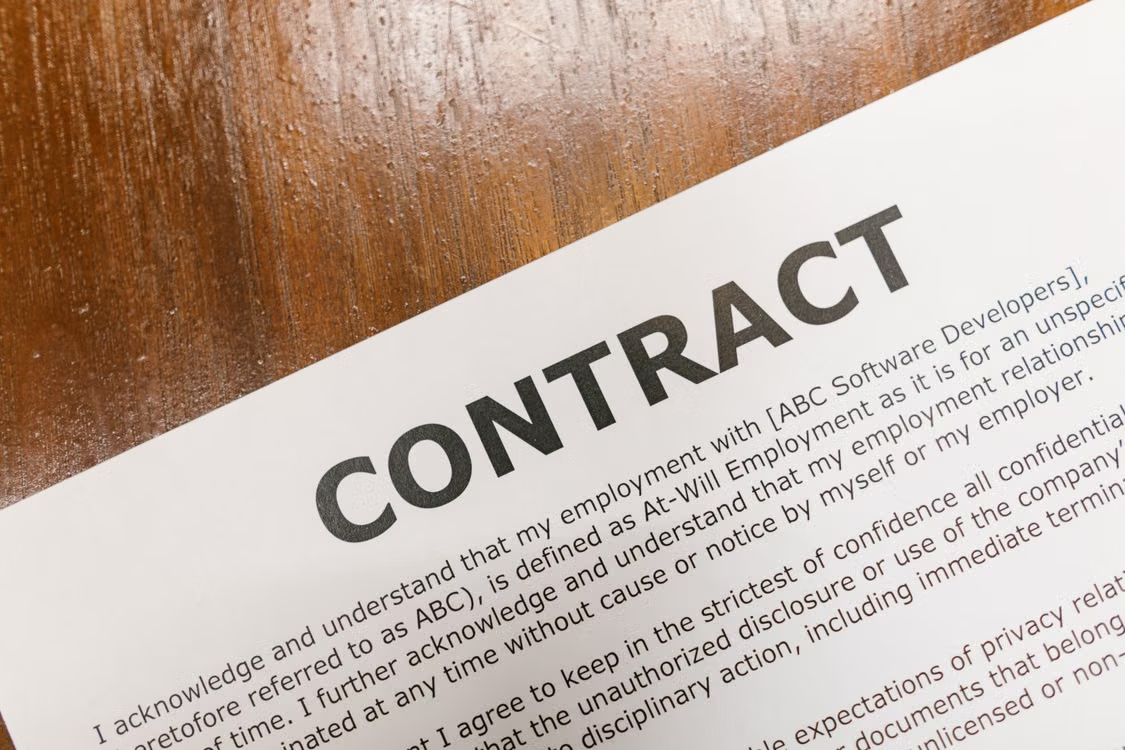
An employment contract is a more formal, detailed agreement that creates specific, enforceable obligations for both sides. It is designed to define the relationship with greater precision and, in many cases, to limit the pure at-will nature of the employment.
A full employment contract commonly addresses:
- Exact compensation structure, including bonuses, commissions, and equity
- Detailed job duties and performance expectations
- Length of the agreement (fixed term or indefinite)
- Termination provisions (notice, for-cause definitions, severance)
- Confidentiality and intellectual-property rules
- Non-compete, non-solicitation, or non-disparagement clauses
- Dispute-resolution methods (arbitration or court)
- Governing law
- How the agreement can be modified
Because these documents create clearer rights and restrictions, they are more common for senior roles, positions involving sensitive information, sales jobs with complex commission plans, and situations where either side wants greater certainty.
The Core Legal Difference
The biggest practical difference lies in how much protection and flexibility each document provides.
In the absence of a contract that says otherwise, most private-sector employment in the United States is at-will. Either party can end the relationship at any time, for almost any lawful reason, without advance notice. An employer can also change duties, schedule, or even pay going forward (subject to minimum-wage and anti-discrimination rules).
A well-drafted employment contract can modify that baseline. It can guarantee a salary for a stated period, require notice before termination, define what counts as “cause,” promise severance, or lock in other terms. In return, it often imposes obligations on the employee—most notably post-employment restrictions.
An offer letter, by contrast, usually does not create those stronger protections. Courts frequently view offer letters as statements of present intent rather than binding promises of future employment on fixed terms. However, this is not absolute. If an offer letter contains very specific promises—such as a guaranteed bonus, a fixed term of employment, or clear severance language—and the candidate relies on those promises, some courts may enforce parts of it under contract or promissory-estoppel principles. The outcome depends heavily on the exact wording and the state.
The safest approach is to assume that a standard offer letter leaves you in an at-will relationship unless clear language creates something more.
When Employers Use Each Document
Many companies send an offer letter first. It allows them to move quickly, secure the candidate, and handle the basic logistics of onboarding. For a large number of roles—especially non-executive positions—the offer letter and the employee handbook together form the main written framework. No lengthy contract is ever signed.
Other employers, particularly in technology, finance, sales, healthcare leadership, or any role with access to valuable relationships or intellectual property, follow the offer letter with a formal employment agreement. Sometimes the detailed contract arrives only after the candidate has already accepted the offer letter and resigned from a previous job. That sequence can create pressure.
Some organizations skip the offer letter entirely and present a full contract as the offer document. Others use a short offer letter that expressly states it is contingent on the candidate signing a separate employment agreement.
Key Areas Where the Documents Often Differ
Compensation details
Offer letters frequently state a base salary and mention that the employee will be eligible for the company’s bonus or benefits programs “according to company policy.” Employment contracts are more likely to spell out bonus formulas, equity grants, vesting schedules, and clawback rules.
Termination and severance
Offer letters often say little beyond confirming at-will status. Contracts commonly define notice periods, for-cause versus without-cause termination, and any severance package.
Restrictive covenants
Non-compete, non-solicitation, and confidentiality provisions rarely appear in short offer letters. They are standard in many formal employment contracts. Because these clauses can limit future job options, their presence is one of the strongest reasons to read a contract carefully.
Job duties
Offer letters may list a title and a brief description. Contracts sometimes include more detailed duties or attach a formal job description—while still often reserving the right to assign additional tasks.
Integration and modification
Contracts usually contain an “entire agreement” clause stating that the written document supersedes prior discussions and that changes must be in writing. Offer letters may lack this language, leaving more room for later disputes about what was promised verbally.
Practical Risks of Relying Only on an Offer Letter
Candidates sometimes treat the offer letter as a complete safety net. That can create problems later:
- The employer changes the start date, reporting structure, or duties before the first day.
- A promised signing bonus is delayed or conditioned on new requirements.
- The detailed contract arrives with restrictive covenants the candidate never expected.
- The employee resigns from a previous job only to discover the new role is less secure than the offer letter suggested.
None of these outcomes is inevitable, and many employers act in good faith. Still, the thinner the written terms, the more the relationship rests on the employer’s ongoing discretion.
What to Do When You Receive an Offer Letter
Read it completely, even if it looks straightforward. Confirm that the salary, title, start date, and any bonus or relocation language match what you discussed. Note whether it states that employment is at-will and whether it is contingent on background checks, signing a separate agreement, or other conditions.
If something important is missing—such as clarity on remote-work expectations, a signing bonus timeline, or equity details—ask for written clarification before you accept. A short email creates a record.
Accepting an offer letter usually creates an obligation to show up and begin work, but it does not necessarily lock in every term for the long term. If a more detailed contract is coming, ask to see it before you resign from your current position when possible.
What to Do When You Receive an Employment Contract
Treat it as a serious legal document. Set aside time to read every section. Pay special attention to compensation mechanics, termination and severance, restrictive covenants, intellectual-property clauses, and dispute-resolution requirements.
Compare the contract with the earlier offer letter. If terms have shifted in a way that disadvantages you, raise the issue promptly. Employers sometimes adjust language during the drafting process; it is easier to address discrepancies before you sign.
Consider professional review for senior roles, complex equity arrangements, or contracts containing non-competes. Many employment attorneys offer flat-fee contract reviews that can highlight risks and suggest negotiation points.
When you negotiate, focus on the issues that matter most to your situation. Base salary is often the least flexible item by the time a formal contract appears; severance, non-compete scope, bonus clarity, and equity acceleration are sometimes more negotiable.
Hybrid Situations and Gray Areas
Real life is rarely perfectly clean. You may receive an offer letter that contains unusually detailed promises. You may be asked to sign a short “employment agreement” that is only two pages long. You may start work on the basis of an offer letter and only later be presented with restrictive covenants as a condition of receiving equity.
In these gray areas, the specific language and the surrounding circumstances matter more than the document’s title. Courts look at whether the parties intended to create binding obligations and whether the terms are sufficiently definite. Because outcomes vary, treating every written document with care is the safest approach.

State-Law Variations
While the general distinction between offer letters and formal contracts holds across most of the United States, state law influences how aggressively courts enforce promises and how they treat restrictive covenants. Some states are more willing to find binding commitments in detailed offer letters. Others strongly protect at-will status. Non-compete enforceability differs dramatically by jurisdiction. If your offer involves relocation or remote work across state lines, the governing-law question becomes especially important.
A Practical Mindset for Candidates
Think of the offer letter as the invitation and the employment contract (when one exists) as the rulebook. The invitation gets you in the door. The rulebook governs how the relationship actually works once you are inside.
You do not need to treat every employer with suspicion. Most companies want successful, long-term hires. At the same time, you are allowed to protect your own interests. Asking thoughtful questions about the documents you are given is a sign of professionalism, not mistrust.
If only an offer letter is provided, understand that you are likely entering an at-will relationship with limited contractual guarantees. If a full contract is provided, read it with the knowledge that it may both give you rights and place restrictions on you. In either case, clarity before you sign—or before you resign from your current role—puts you on stronger footing.
Closing Thoughts
The difference between a job offer letter and an employment contract is more than a matter of length or formality. It is a difference in how much of the relationship is left to discretion and how much is fixed in enforceable promises. Offer letters are useful, efficient tools for confirming the basics of an offer. Employment contracts create a more detailed and often more binding framework.
Neither document is automatically better. What matters is that you understand which one you are receiving, what it actually commits both sides to, and where the gaps or risks lie. Taking the time to read, ask questions, and, when appropriate, negotiate is one of the most effective ways to begin a new role with open eyes.
You deserve to know the terms that will shape your work life. Whether the paper in front of you is one page or fifteen, treat it as information that belongs to you. That simple habit of careful review has helped many people avoid later regrets and start their new positions with greater confidence and clearer expectations.

William Radcliffe is the author behind meyy.org. With a strong interest in workplace rights and practical guidance for employees, he focuses on turning complex U.S. labor laws and employment issues into clear, approachable, and actionable information.Drawing from years of observing real workplace challenges, William writes to help readers better understand their rights, recognize important issues early, and feel more confident when navigating difficult situations at work.