For years, the federal solar tax credit has been one of the most important financial incentives available to U.S. homeowners considering solar energy. The credit helped reduce the federal income tax burden associated with installing qualifying solar equipment and made residential solar more affordable for millions of households.
However, 2026 is a major transition year for the federal residential solar incentive.
The rules changed after the passage of the One Big Beautiful Bill Act (OBBBA) in July 2025. The federal Residential Clean Energy Credit under Section 25D was terminated for expenditures made after December 31, 2025. The Internal Revenue Service specifically states that the credit is not available for qualifying expenditures made after that date. IRS
That means homeowners researching solar in 2026 should be careful with older articles, advertisements, and sales materials that still describe a 30% federal residential solar tax credit as though it remains available for new installations.
The change is especially important because the previous credit had been a major component of the economics of residential solar. Under the former rules, qualifying solar-electric property, battery storage, and certain other residential clean-energy technologies could generally qualify for a credit equal to 30% of eligible costs. IRS
This article explains what happened to the federal residential solar tax credit, who may still be able to claim credits for qualifying 2025 expenditures, how the rules affect solar installations completed in 2026, what homeowners should do now, and which other incentives may still be available.
What Was the Federal Solar Tax Credit?
The federal residential solar incentive was known as the Residential Clean Energy Credit under Section 25D of the Internal Revenue Code.
Before its termination, the credit generally allowed eligible homeowners to claim 30% of qualifying residential clean-energy expenditures.
Eligible technologies included:
- Solar electric panels
- Solar water-heating equipment
- Qualified battery storage
- Small wind systems
- Geothermal heat pumps
- Certain fuel-cell equipment
The IRS confirmed that qualified solar-electric property and qualifying battery storage were among the expenditures eligible for the 30% credit under the previous rules. IRS
The credit had become particularly significant for homeowners because there was no overall dollar cap on the credit for most qualifying residential clean-energy property. IRS
Is the 30% Federal Solar Tax Credit Available in 2026?
For new residential solar expenditures made after December 31, 2025, the federal Residential Clean Energy Credit is no longer available.
This is the most important 2026 change homeowners need to understand.
The IRS states that the OBBBA accelerated the termination of Section 25D and that the residential clean energy credit will not be allowed for expenditures made after December 31, 2025. IRS
Therefore, homeowners should be cautious about websites or solar advertisements that simply say:
“Get a 30% federal solar tax credit.”
That statement can be outdated if it is referring to a new residential solar installation occurring in 2026.
Why Did the Federal Solar Tax Credit Change?
The change came from federal legislation enacted in 2025.
The One Big Beautiful Bill Act accelerated the termination of several energy-related tax incentives.
For residential clean energy, the legislation ended the Section 25D credit for expenditures made after December 31, 2025. IRS
The change is significant because previous federal policy had extended the residential clean-energy credit much further into the future.
Homeowners who remember seeing information about a 30% solar credit continuing through the early 2030s may therefore encounter conflicting information online.
The important distinction is between the old rules and the rules applicable after the 2025 legislative changes.
What Happened to Solar Installations Completed in 2025?
The termination date does not mean that homeowners who legitimately qualified for the credit in 2025 automatically lose it.
If qualifying expenditures were made under the applicable 2025 rules, homeowners may still claim the credit when filing their 2025 federal tax return, assuming all eligibility requirements were met.
The IRS explains that residential clean-energy costs are generally treated as paid when the original installation is completed. IRS
This distinction is extremely important.
Simply paying a solar company before the end of 2025 was not necessarily enough if the qualifying installation was not completed until 2026.
Does Paying for Solar in 2025 Guarantee the Tax Credit?
No.
This is one of the most important details homeowners should understand.
The IRS specifically states that for Section 25D, an expenditure is generally treated as made when the original installation is completed. If installation is completed after December 31, 2025, the expenditure is treated as occurring after that date, which prevents the homeowner from claiming the Section 25D credit. IRS
For example:
Scenario 1: Installation Completed in 2025
A homeowner purchases and installs qualifying solar equipment and the original installation is completed in December 2025.
If all other requirements are satisfied, the homeowner may be eligible to claim the applicable 2025 credit.
Scenario 2: Deposit Paid in 2025, Installation Completed in 2026
A homeowner signs a contract and pays a deposit in December 2025, but the qualifying installation is not completed until January 2026.
The payment date alone does not make the 2026 installation eligible for the former Section 25D credit.
The IRS specifically addresses this situation in its guidance. IRS
Can You Still Claim a 2025 Solar Tax Credit in 2026?
Potentially, yes.
There is an important difference between claiming a credit in 2026 and installing qualifying solar in 2026.
A homeowner who completed a qualifying installation during 2025 may file their 2025 federal tax return in 2026 and claim the credit if they meet the requirements.
In other words:
Tax return filed in 2026 ≠ installation made in 2026.
A 2025 qualifying expenditure can still be reported on the appropriate 2025 tax return.
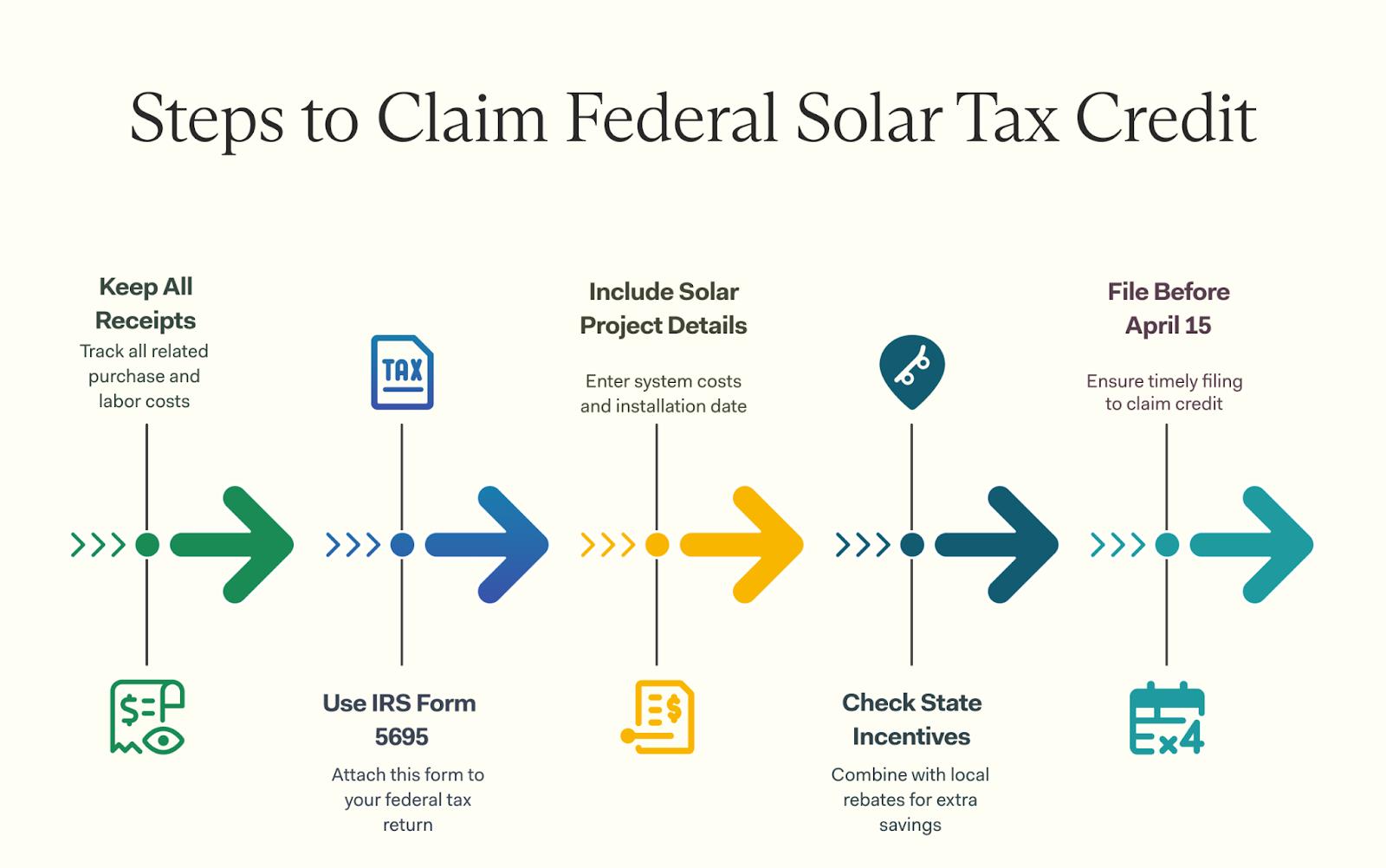
The IRS directs taxpayers to Form 5695, Residential Energy Credits, for calculating and claiming the residential energy credits. IRS
What Is Form 5695?
Form 5695 is the IRS form used to calculate residential energy credits.
The IRS explains that Form 5695 is used for residential energy credits, including the Residential Clean Energy Credit and the Energy Efficient Home Improvement Credit. IRS
For a homeowner claiming an eligible 2025 residential clean-energy credit, the form is an important part of the federal tax filing process.
Homeowners should retain documentation supporting the installation.
What Documents Should Homeowners Keep?
The IRS recommends keeping purchase receipts and installation records because the documentation may be needed if a tax return is audited. IRS
Homeowners should consider retaining:
- Solar installation contract
- Final invoice
- Equipment invoices
- Installation completion documentation
- Payment records
- Solar panel information
- Battery information, if applicable
- Installer documentation
- Permit records
- Utility interconnection documentation
- Copies of relevant tax forms
Keeping organized records can make it much easier to substantiate the credit if questions arise later.
Does the Former Federal Credit Cover Solar Batteries?
Under the previous Section 25D rules, qualifying battery storage technology could qualify for the Residential Clean Energy Credit.
The IRS states that qualifying battery storage technology with a capacity of at least 3 kilowatt-hours was included among eligible residential clean-energy property. IRS
This was important because battery storage became increasingly popular among homeowners who wanted:
- Backup electricity
- Greater energy independence
- Better use of solar generation
- Protection against power outages
- Time-of-use energy management
However, the same Section 25D termination applies to qualifying expenditures made after December 31, 2025.
What About Solar Shingles?
Solar shingles can have a different tax treatment from conventional roofing materials.

The IRS has explained that traditional roofing materials and structural components generally do not qualify merely because they support solar panels.
However, certain solar roofing tiles and solar shingles can qualify because they themselves generate electricity while also serving a roofing function. IRS
Homeowners should therefore distinguish between:
Traditional roof replacement
and
Qualified solar-generating roofing equipment.
This distinction can matter when reviewing tax documentation.
Can You Claim the Federal Credit for a New Solar Installation in 2026?
Under the current federal rules, a homeowner generally cannot claim the former Section 25D residential clean-energy credit for qualifying expenditures made after December 31, 2025. IRS
This means a homeowner beginning a new residential solar project in 2026 should not assume that 30% of the installation cost can be deducted from federal income taxes through the former residential solar credit.
Instead, homeowners should investigate other available financial incentives.
Are State Solar Incentives Still Available?
Federal changes do not automatically eliminate state and local solar programs.
Some states may continue to offer:
- State tax incentives
- Rebates
- Performance-based incentives
- Solar renewable energy credits
- Property-tax incentives
- Sales-tax exemptions
- Utility rebates
- Battery incentives
- Local clean-energy programs
The availability and value of these programs varies by state and utility territory.
Therefore, a homeowner in California could face a very different incentive environment from someone in Texas, Arizona, New York, Massachusetts, or another state.
What About Utility Rebates?
Some utilities offer incentives for solar and battery storage.
These programs can be designed to encourage:
- Distributed solar generation
- Battery storage
- Demand response
- Peak-load management
- Grid resilience
Utility programs can change frequently, so homeowners should verify current terms directly with their electricity provider.
A solar quote should clearly identify whether any utility incentive is being assumed in the financial calculations.
Can Net Metering Still Help Solar Homeowners?
Net metering and related compensation programs are separate from the federal residential clean-energy tax credit.
Under net-metering arrangements, excess electricity generated by a solar system may be credited according to the rules established by a particular utility or state.
However, the value of exported electricity varies substantially.
Some utilities provide relatively favorable compensation, while others use different export rates or alternative billing structures.
This is why homeowners should examine the local utility’s current solar compensation rules before calculating expected savings.
How the End of the Federal Credit Changes Solar Economics
Without the former federal residential tax credit, the upfront economics of a new residential solar system can look different.
Suppose a hypothetical solar installation costs:
$25,000
Under the former 30% credit structure, an eligible homeowner could have potentially received:
$25,000 × 30% = $7,500
That would leave:
$25,000 − $7,500 = $17,500
before considering other incentives or financial factors.
For a new qualifying residential installation completed under the post-2025 rules, homeowners should not automatically assume that $7,500 federal residential clean-energy credit is available.
This can make accurate solar quotes and return-on-investment calculations even more important.
Does Solar Still Make Sense Without the Federal Credit?
It can.
The absence of the former federal residential tax credit does not mean solar automatically becomes a poor investment.
The economics depend on several factors.
Electricity Prices
Homes with high electricity costs may have greater potential savings from generating their own electricity.
Solar Resource
Homes in areas with strong sunlight may generate more electricity from the same system size.
System Price
Lower installation costs can improve the economics.
Utility Compensation
The value of excess solar electricity can have a major impact.
Financing
Loan terms can significantly affect the total cost of a solar installation.
Energy Consumption
Homes that use more electricity may require larger systems.
Battery Storage
Adding batteries can increase upfront costs but may provide backup power and additional energy-management benefits.
How Homeowners Should Evaluate Solar in 2026
Because the federal residential tax credit has changed, homeowners should focus more closely on the entire financial picture.
A good solar analysis should include:
Total installation cost
System size
Expected annual electricity production
Current electricity bill
Projected utility-rate increases
Value of exported electricity
Financing costs
Battery costs
Maintenance expectations
Warranty terms
Available state and utility incentives
Rather than asking only:
“How much is the federal tax credit?”
homeowners should ask:
“What will my complete solar investment cost, and how much electricity will it save me over time?”
Be Careful With Outdated Solar Advertisements
The solar industry contains a large amount of older content.
You may still find pages discussing the 30% residential federal solar tax credit as though the incentive automatically applies to installations completed in 2026.
Homeowners should check the date of the information and verify federal tax rules through the IRS.
The IRS’s current guidance specifically states that Section 25D residential clean-energy credits are not available for expenditures made after December 31, 2025. IRS
This makes current information particularly important when comparing solar proposals.
Federal Solar Incentives for Businesses Are Different
Homeowners should also avoid confusing residential solar incentives with federal incentives available to businesses and larger energy projects.
The tax rules for commercial solar, utility-scale solar, and other clean-energy projects are structured differently.
For example, the OBBBA also changed the federal clean-electricity production and investment credits applicable to certain wind and solar facilities. The IRS has issued separate guidance addressing the termination provisions and construction requirements for those projects. IRS
Therefore, an article discussing commercial or utility-scale solar tax credits should not automatically be applied to a homeowner’s residential installation.
What Homeowners Should Do Before Installing Solar in 2026
Before signing a solar contract, homeowners should take several steps.
Get Multiple Quotes
Compare at least several installers when possible.
Ask for the Cash Price
Do not evaluate the project solely based on the monthly payment.
Review Equipment
Identify the exact solar panels, inverters, batteries, and other major equipment.
Check Local Incentives
Research current state, utility, and local programs.
Calculate Your Expected Savings
Use your actual electricity consumption rather than a generic household estimate.
Understand Your Utility Rules
Find out how excess solar generation is compensated.
Review the Contract
Look for cancellation provisions, warranties, ownership terms, financing costs, and installation responsibilities.
Verify Tax Information
If a salesperson claims you qualify for a federal tax incentive, ask for the specific current IRS authority supporting the claim.
Frequently Asked Questions
Is the 30% federal solar tax credit available in 2026?
For new residential qualifying expenditures made after December 31, 2025, the former Section 25D Residential Clean Energy Credit is no longer available. IRS
Can I claim a 2025 solar credit when I file taxes in 2026?
Potentially, if the qualifying installation and expenditures meet the applicable 2025 requirements. Filing the tax return in 2026 does not turn a 2025 installation into a 2026 expenditure. The IRS provides Form 5695 for residential energy credits. IRS
Does paying a solar deposit in 2025 qualify the entire project?
Not necessarily. The IRS states that Section 25D expenditures are generally treated as made when the original installation is completed. IRS
Did the federal solar credit cover batteries?
Under the former rules, qualifying battery storage technology of at least 3 kWh could qualify for the Residential Clean Energy Credit. IRS
Are state solar incentives still available?
Some states and utilities may continue to offer incentives, but availability varies. Homeowners should check programs applicable to their location.
Where can homeowners verify federal solar tax-credit information?
The IRS is the best starting point for current federal tax-credit rules, forms, and official guidance. IRS
Final Thoughts
The federal residential solar tax-credit landscape changed substantially heading into 2026.
The former 30% Residential Clean Energy Credit under Section 25D is no longer available for qualifying residential expenditures made after December 31, 2025. IRS
For homeowners who completed qualifying solar installations in 2025, however, the ability to claim the applicable credit when filing their 2025 federal tax return in 2026 may still be relevant.
For homeowners installing solar for the first time in 2026, the financial calculation needs to start with the current rules, not older articles that describe the former 30% federal residential credit.
Solar can still provide potential long-term electricity savings and energy independence, but homeowners should carefully compare installation prices, electricity rates, utility compensation, financing, battery options, state incentives, and expected energy production.
Most importantly, verify federal tax information directly with the IRS or a qualified tax professional before making a major solar investment. Tax rules can be complex, and eligibility depends on the specific facts of the homeowner and the property.

Seraphina Vale is a passionate content writer and blogger with 3 years of blogging experience, specializing in creating engaging, well-researched, and reader-focused articles. She enjoys breaking down complex topics into clear, practical insights that help readers stay informed and make confident decisions.