Missing a mortgage payment can be stressful, especially if you are already dealing with unexpected expenses, reduced income, medical bills, job changes, or other financial challenges. The good news is that one missed mortgage payment does not usually mean you immediately lose your home. However, ignoring the problem can allow fees, delinquency, credit damage, and eventually foreclosure proceedings to become much more serious.
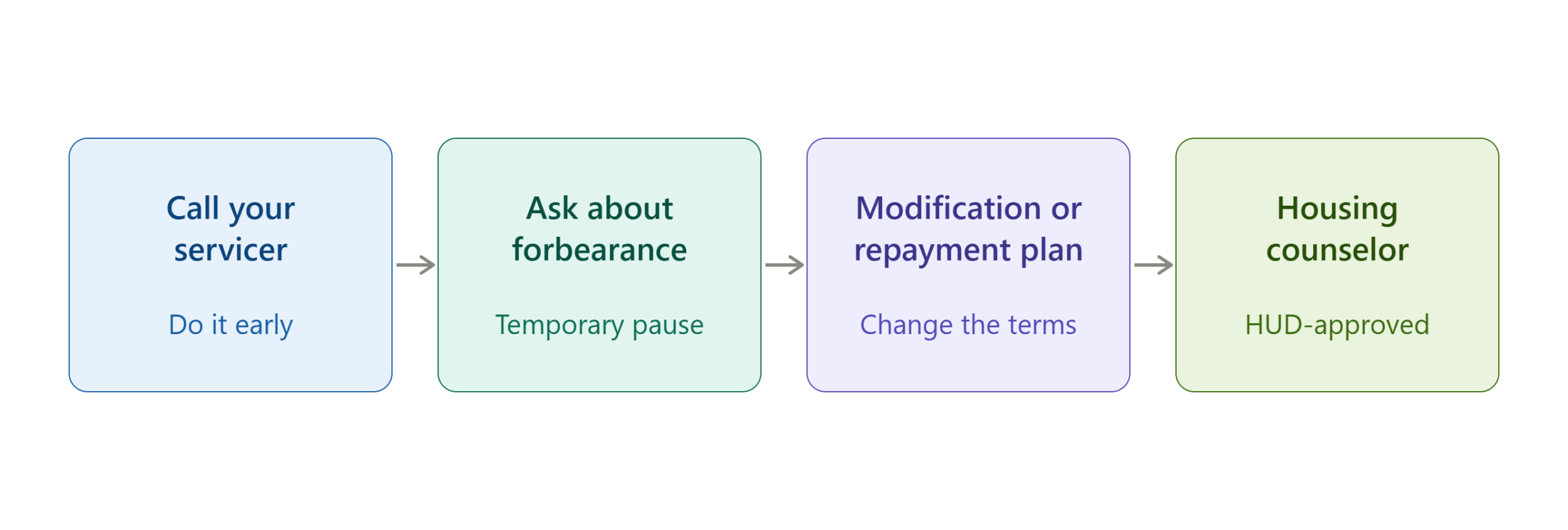
Understanding what happens after a missed mortgage payment can help you take action before the situation gets worse. Mortgage servicers generally provide several ways for struggling homeowners to address delinquent payments, and the earlier you communicate with your servicer, the more options you may have. HUD also advises homeowners to contact their lender as soon as they realize they cannot make their payments.
The exact consequences depend on how late the payment is, the terms of your mortgage, your loan type, your servicer’s policies, and applicable federal and state laws. A payment that is only a few days late may have very different consequences from a payment that is 30, 60, 90, or 120 days overdue.
This guide explains what happens when you miss a mortgage payment, how mortgage late fees work, when a missed payment can affect your credit score, what happens after multiple missed payments, when foreclosure becomes a possibility, and what you can do to protect your home.
What Is Considered a Missed Mortgage Payment?
A mortgage payment is considered missed when your servicer does not receive the required periodic payment by the applicable deadline.
Your mortgage documents determine the payment due date and any grace period that may apply. Many mortgage contracts include a grace period, meaning you may have additional time to make the payment without being charged a late fee. However, the exact terms vary by loan.
The Consumer Financial Protection Bureau (CFPB) recommends checking your mortgage documents to understand the applicable late-fee rules. Late fees generally must be authorized by your mortgage documents, and state law may also restrict how much can be charged.
It is important to distinguish between:
- Being late according to the payment due date
- Being charged a late fee
- Being reported as delinquent to credit reporting companies
- Being in default
- Being at risk of foreclosure
These are not necessarily the same thing.
A homeowner can be late on a payment without immediately facing foreclosure.
What Happens If You Are a Few Days Late?
If you miss your mortgage payment but make it during the applicable grace period, you may not face a late fee depending on the terms of your loan.
If the grace period expires, your servicer may charge a late fee.
For example, suppose your mortgage payment is due on the first of the month and your mortgage contract provides a grace period. If you make the payment during that grace period, the payment may be accepted without a late charge.
If you wait beyond the grace period, a late fee may apply.
The important point is that a few days of lateness is generally very different from being 30 or more days delinquent.
Your mortgage statement and loan documents should tell you how much you owe, when it is due, and what fees may apply.
Can a Mortgage Company Charge a Late Fee?
Yes. A mortgage servicer may charge a late fee when a payment is not made according to the terms of the mortgage.
However, the amount of the fee is not simply whatever the servicer chooses. CFPB guidance states that late fees can be charged only in the amount authorized by the mortgage documents, while state law may also limit the amount.
Before assuming a late fee is correct, review:
- Your mortgage contract
- Your monthly mortgage statement
- Your Closing Disclosure
- Applicable state requirements
- The date the servicer actually received your payment
If you believe a late fee was incorrectly charged, contact your servicer and request an explanation.
What Happens If You Are 30 Days Late?
A mortgage payment that is 30 days overdue is significantly more serious than a payment that is only a few days late.
According to CFPB consumer guidance, a mortgage loan that is 30 days past due may be reported on your credit report. A reported late mortgage payment can negatively affect your credit score.
At this point, you may also have:
- A late fee
- A delinquent mortgage account
- Negative credit reporting
- Additional communication from your servicer
- A larger amount required to bring the account current
The exact reporting practices and timing can depend on the loan and servicer, but homeowners should not assume that a 30-day delinquency is harmless.
Does One Missed Mortgage Payment Ruin Your Credit?
Not necessarily.
If you miss a payment but correct the problem before it becomes reportable as a serious delinquency, the consequences may be considerably smaller.
However, once a late payment is reported to the credit reporting companies, it can negatively affect your credit profile.
A mortgage is one of the largest debts most consumers have, so maintaining a consistent payment history is important.
Negative information can generally remain on a credit report for up to seven years, although the exact effect on your credit score can change over time.
What Happens If You Are 60 Days Late?
If you miss two consecutive mortgage payments, the situation becomes more serious.
You may now owe:
- The first missed payment
- The second missed payment
- Accrued late fees
- Potential additional charges
- Any other amounts required under your mortgage agreement
Your servicer will likely communicate with you more frequently.
At this point, it is important not to ignore phone calls, letters, emails, or notices from your mortgage servicer.
The CFPB encourages borrowers who are struggling with mortgage payments to contact their servicer as soon as possible because loss-mitigation options may be available.
What Happens If You Are 90 Days Late?
Being approximately 90 days behind is a serious mortgage delinquency.
At this point, your outstanding balance may have grown substantially because several payments are past due.
You may also receive more formal notices concerning your delinquency and possible foreclosure avoidance options.
However, being 90 days behind does not necessarily mean that your home will immediately be foreclosed upon.
Federal mortgage servicing rules generally restrict when the legal foreclosure process can begin. The CFPB states that, generally, the legal foreclosure process cannot start until a borrower is at least 120 days delinquent, although exceptions and specific circumstances can apply. State foreclosure procedures also vary.
This does not mean homeowners should wait until 120 days to act.
The earlier you contact your servicer, the more time there may be to evaluate possible solutions.
What Happens If You Are 120 Days Late?
At approximately 120 days delinquent, the situation becomes extremely serious.
The CFPB states that, generally, the legal foreclosure process cannot begin until the mortgage is at least 120 days delinquent. Once foreclosure proceedings begin, the timeline toward a foreclosure sale varies significantly by state.
This is why the 120-day point should not be treated as a deadline.
You should contact your mortgage servicer before reaching this stage if you know you cannot catch up.
Depending on your circumstances, you may be evaluated for loss-mitigation options that could help you retain your home.
Mortgage Payment Timeline: What Can Happen?
A simplified timeline looks like this:
| Payment Status | Potential Consequences |
|---|---|
| Few days late | Possible grace period or late fee |
| Less than 30 days late | Late fee may apply depending on loan terms |
| 30 days late | May be reported to credit reporting companies |
| 60 days late | Multiple missed payments and increasing delinquency |
| 90 days late | Serious delinquency and greater foreclosure risk |
| 120+ days late | Legal foreclosure process may generally begin, subject to applicable rules |
| Foreclosure proceedings | Legal process varies by state |
This is only a general illustration. Your actual mortgage documents, loan type, servicer, and state laws determine what happens in your particular situation.
Can You Lose Your House After Missing One Payment?
Usually, missing one mortgage payment does not mean you immediately lose your house.
Foreclosure is generally a legal process rather than an instant consequence of one missed payment.
However, a missed payment can become the beginning of a much larger problem if it is not resolved.
The greatest danger is often not the first missed payment itself but allowing the delinquency to continue without communicating with the mortgage servicer.
HUD specifically advises homeowners not to assume financial problems will simply correct themselves and recommends contacting the lender as soon as they know they cannot make payments.
Will a Missed Mortgage Payment Affect Your Credit Score?
It can.
A mortgage payment that becomes sufficiently delinquent may be reported to credit reporting companies.
Once reported, the late payment can negatively affect your credit score.
The impact depends on factors such as:
- How late the payment is
- Whether it is reported
- Your existing credit history
- The scoring model used
- Whether additional payments become delinquent
A single reported late payment can be damaging, particularly for someone with an otherwise strong payment history.
Multiple late mortgage payments can create a much more serious credit problem.
How Long Does a Missed Mortgage Payment Stay on Your Credit Report?
Negative payment information can generally remain on a consumer credit report for up to seven years.
That does not mean your credit score will remain equally damaged for seven years.
The effect of negative information can diminish as you establish a new record of on-time payments.
If a late payment is reported incorrectly, you can dispute the information and request an investigation.
Do not pay a company simply because it promises to remove accurate negative information from your credit report. CFPB guidance notes that accurate negative information generally cannot simply be removed by a credit-repair company.
Does a Missed Mortgage Payment Increase Your Mortgage Balance?
A missed payment does not necessarily mean your principal balance increases by the entire missed payment.
Your mortgage payment normally consists of several components, potentially including:
- Principal
- Interest
- Property taxes
- Homeowners insurance
- Mortgage insurance
- Other escrow-related amounts
When you miss a payment, you may owe the unpaid amounts plus applicable fees and other charges.
If the delinquency continues, the amount required to bring the loan current can become increasingly difficult to manage.
Some loss-mitigation programs may restructure or otherwise resolve past-due amounts, but the treatment depends on the program and loan type.
What Is Mortgage Delinquency?
Mortgage delinquency generally means that the borrower has failed to make required payments by the applicable deadline.
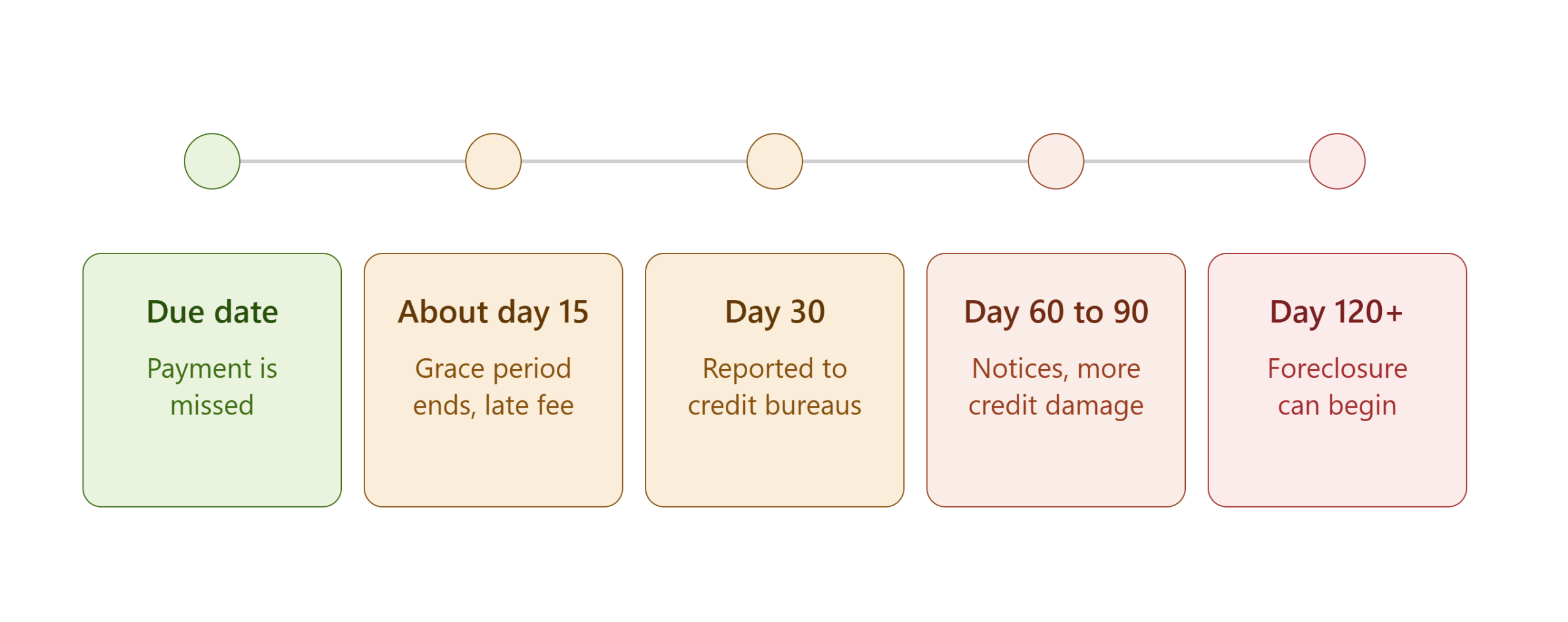
Delinquency can progress through different stages.
For example:
Current → Late → 30 days delinquent → 60 days delinquent → 90 days delinquent → 120+ days delinquent → Foreclosure process
The exact legal and servicing consequences vary.
The important lesson is that delinquency generally becomes more difficult to resolve the longer it continues.
What Is Mortgage Default?
Default is a more serious stage than simply being a few days late.
The exact definition can depend on the mortgage contract, loan program, and applicable law.
Default can potentially trigger additional contractual remedies and eventually foreclosure proceedings.
Homeowners should not wait until they believe they are officially in “default” before asking for assistance.
If you already know that you will not be able to make the next payment, contact your servicer immediately.
What Is Foreclosure?
Foreclosure is the legal process through which a lender or other authorized party seeks to recover the property securing a mortgage after the borrower fails to meet the loan obligations.
Foreclosure laws vary by state.
Depending on the state, foreclosure may involve judicial proceedings, nonjudicial procedures, notices, hearings, sales, and other legal steps.
The process can take considerable time, but homeowners should never assume that they have unlimited time.
If you receive foreclosure documents or legal notices, consider obtaining qualified legal advice promptly.
Can a Mortgage Servicer Help If You Miss Payments?
Yes.
Depending on your circumstances and loan type, your mortgage servicer may offer or evaluate you for various loss-mitigation options.
The CFPB lists potential options such as:
- Repayment plans
- Forbearance
- Loan modification
- Refinancing in some circumstances
- Short sale
- Deed-in-lieu of foreclosure
Not every option is available to every borrower. Eligibility depends on the mortgage, financial circumstances, investor or program requirements, and other factors.
What Is a Mortgage Repayment Plan?
A repayment plan allows you to catch up on missed payments by adding part of the overdue amount to your regular monthly mortgage payment for a period of time.
For example, suppose you normally pay $2,000 per month and you have fallen behind by $6,000.
A servicer might establish a repayment arrangement under which you pay your regular $2,000 plus an additional amount toward the overdue balance.
The exact terms vary.
A repayment plan can be useful if your financial hardship was temporary and you can afford the higher monthly payment.
The CFPB warns borrowers to make sure they can actually afford the new payment before agreeing to a repayment plan.
What Is Mortgage Forbearance?
Forbearance is a temporary arrangement that may allow a borrower to pause or reduce mortgage payments for a specific period.
It is generally designed to provide temporary financial relief.
However, forbearance does not automatically mean the missed payments disappear.
Depending on the agreement, you may eventually need to repay the amounts that were paused or reduced.
That repayment could potentially occur through:
- A repayment plan
- A lump-sum payment
- A loan modification
- Another loss-mitigation arrangement
Always ask your servicer exactly how the missed payments will be handled before accepting a forbearance agreement.
What Is a Mortgage Loan Modification?
A loan modification changes one or more terms of an existing mortgage.
Depending on the program and circumstances, a modification may potentially change:
- The interest rate
- The loan term
- The principal balance treatment
- The payment structure
The objective can be to make the mortgage more affordable or resolve delinquent amounts.
For example, FHA’s loss-mitigation program includes loan modifications among its home-retention options for eligible borrowers.
Can You Refinance After Missing Mortgage Payments?
Possibly, but it may be more difficult.
Refinancing usually requires qualifying for a new mortgage.
Lenders may evaluate:
- Credit history
- Income
- Debt-to-income ratio
- Employment
- Property value
- Payment history
- Equity
- Loan-to-value ratio
A recent mortgage delinquency can make qualifying more difficult.
Therefore, refinancing should not automatically be considered a solution after a missed payment.
If you are already struggling financially, speak with your current mortgage servicer about loss mitigation before assuming refinancing is available.
What If You Cannot Afford Your Mortgage Anymore?
If your financial situation has changed permanently, simply catching up on one missed payment may not solve the underlying problem.
For example, a homeowner may experience:
- Permanent income reduction
- Job loss
- Business income decline
- Divorce
- Major unexpected expenses
- Increased housing costs
- Long-term debt problems
In these situations, contact the mortgage servicer as soon as possible.
Potential solutions can include loan modification, selling the property, a short sale, or a deed-in-lieu of foreclosure, depending on eligibility.
What Is a Short Sale?
A short sale occurs when a home is sold for less than the amount owed on the mortgage and the lender or servicer agrees to the transaction under applicable requirements.
Short sales can sometimes be an alternative to foreclosure for homeowners who cannot afford the mortgage and do not have enough equity to pay off the loan.
However, the consequences can vary, so homeowners should understand how the transaction could affect their credit, taxes, remaining debt, and future borrowing ability.
What Is a Deed-in-Lieu of Foreclosure?
A deed-in-lieu of foreclosure involves voluntarily transferring ownership of the property to the lender or another authorized party to satisfy the mortgage obligation under an agreed arrangement.
It can sometimes provide an alternative to foreclosure.
However, eligibility requirements and the treatment of any remaining debt vary.
You should understand the complete agreement before signing anything.
What Happens If You Send a Partial Mortgage Payment?
A partial payment does not necessarily bring your mortgage current.
Mortgage servicers may have specific rules for handling payments that are less than the full periodic payment.
The CFPB explains that, depending on the circumstances and applicable requirements, a servicer may credit a partial payment, return it, or place it in a suspense account until enough money is received to make a full periodic payment.
Therefore, if you cannot make the full payment, contact the servicer before sending a partial amount and ask how it will be handled.
What Should You Do If You Know You Will Miss Your Mortgage Payment?
The best approach is to act before the payment becomes seriously delinquent.
Contact Your Mortgage Servicer
Call the number on your mortgage statement.
Explain:
- Why you cannot make the payment
- Whether the problem is temporary or permanent
- Your current income
- Your expenses
- Your available assets
- How much you can realistically afford
The CFPB specifically recommends contacting your servicer as soon as possible when you are worried about missing a mortgage payment.
Ask About Loss-Mitigation Options
Ask the servicer:
- Do I qualify for a repayment plan?
- Is forbearance available?
- Could I qualify for a loan modification?
- What amount do I need to bring the loan current?
- Will the missed payment be reported?
- What documents do you need from me?
- What deadlines do I need to meet?
Write down the name of the representative and the date of every conversation.
Review Your Mortgage Statement
Your statement can help you determine:
- Amount currently due
- Past-due amount
- Late fees
- Principal balance
- Escrow information
- Servicer contact information
If something appears incorrect, ask the servicer to investigate it.
Do Not Ignore Your Mortgage Servicer
Ignoring calls and letters generally does not make the problem disappear.
In fact, it can make the situation more difficult because you may miss deadlines or opportunities to apply for assistance.
Federal servicing rules require mortgage servicers to take certain actions when borrowers become delinquent, including contacting borrowers and providing information about potential loss-mitigation options under applicable circumstances.
Respond promptly to requests for financial documents.
When Should You Contact a HUD-Approved Housing Counselor?
You can contact a HUD-approved housing counselor if you are:
- Already behind on your mortgage
- Worried about missing a payment
- Receiving foreclosure notices
- Unsure which assistance option is appropriate
- Having difficulty communicating with your servicer
The CFPB notes that HUD-approved housing counseling agencies can provide assistance at little or no cost and help borrowers understand available foreclosure-avoidance options.
This can be particularly useful if you feel overwhelmed by the mortgage process.
What If Your Mortgage Servicer Makes a Mistake?
Mortgage servicing errors can happen.
For example, you might believe you made a payment on time but the servicer incorrectly records it as late.
If you believe there is an error, document the issue and contact the servicer.
Depending on the issue, federal rules provide procedures for submitting a notice of error or request for information. The servicer generally must respond within specified timeframes.
Keep:
- Bank statements
- Payment confirmations
- Mortgage statements
- Emails
- Letters
- Screenshots
- Servicer correspondence
Good documentation can become extremely valuable if there is a dispute.
Can a Missed Mortgage Payment Stop You From Buying Another House?
A mortgage delinquency can make qualifying for another mortgage more difficult.
Future lenders may review your payment history, credit report, debt obligations, income, and other financial information.
A serious delinquency or foreclosure can have a particularly significant effect.
However, a missed payment does not necessarily mean you can never buy another home.
The impact depends on the circumstances and how your credit and finances recover over time.
How Does Foreclosure Affect Future Homeownership?
Foreclosure can significantly damage your credit profile.
The CFPB states that foreclosure information generally remains on a credit report for seven years from the foreclosure date.
However, a foreclosure does not permanently prevent someone from buying another home.
Mortgage eligibility after foreclosure depends on the type of mortgage, lender requirements, credit recovery, financial circumstances, and applicable waiting periods.
Common Mistakes to Avoid After Missing a Mortgage Payment
Waiting Too Long to Call
This is one of the biggest mistakes.
The sooner you contact your servicer, the more time you may have to explore possible solutions.
Assuming One Missed Payment Means Foreclosure
One missed payment generally does not mean you immediately lose your home.
Do not panic, but do take action.
Ignoring Letters From the Servicer
Important deadlines and assistance information may arrive by mail.
Open and review every notice.
Taking Out Expensive Debt Without a Plan
Using high-interest credit cards or other expensive borrowing to repeatedly cover mortgage payments may only move the problem elsewhere.
Consider your entire financial situation before borrowing additional money.
Paying a Foreclosure-Rescue Scam
Be extremely careful with companies that promise guaranteed foreclosure prevention.
The CFPB warns consumers about scams involving upfront fees, guaranteed loan modifications, requests to sign over property title, instructions to stop paying the mortgage, or claims of government affiliation.
Legitimate help is available through your servicer and HUD-approved housing counseling agencies.
How to Catch Up on a Missed Mortgage Payment
If your financial problem was temporary, you may be able to catch up using:
- Savings
- Reduced discretionary spending
- Additional employment income
- A repayment plan
- Temporary assistance
- A legitimate loss-mitigation program
Before using savings to make a large catch-up payment, make sure you will still have enough money for essential expenses and future mortgage payments.
The goal is not simply to make one payment.
The goal is to establish a sustainable payment plan.
Example: Missing One $2,500 Mortgage Payment
Imagine your monthly mortgage payment is $2,500.
You miss one payment because of an unexpected financial emergency.
If your contract allows a grace period and you pay within that period, you may avoid a late fee.
If you pay after the grace period, a late fee may apply.
If the payment remains unpaid long enough to become 30 days delinquent, it may be reported to credit reporting companies.
If you continue missing payments, the financial problem grows:
One missed payment → Two missed payments → Three missed payments → Serious delinquency → Potential foreclosure process
The exact timeline and consequences vary, but the example demonstrates why early action matters.
Example: What Happens When a Homeowner Misses Three Payments?
Suppose a homeowner has a $2,500 monthly mortgage payment.
After three missed payments, the homeowner could potentially owe approximately:
$2,500 × 3 = $7,500
That is before considering applicable late fees and other charges.
The homeowner now has a much larger amount to resolve than if the issue had been addressed after the first missed payment.
A repayment plan or other loss-mitigation solution might be considered depending on eligibility.
Is It Better to Miss a Mortgage Payment or a Credit Card Payment?
There is no universal answer because everyone’s financial situation is different.
However, a mortgage is secured by your home, meaning failure to meet the mortgage obligation can eventually put the property at risk.
Credit cards are generally unsecured debts, while a mortgage is secured by real estate.
If you cannot pay all of your bills, consider speaking with a qualified financial counselor rather than simply choosing which creditors to ignore.
If you are specifically struggling with your mortgage, contact the mortgage servicer immediately.
Frequently Asked Questions
What happens if I miss my mortgage payment by one day?
Your mortgage contract may provide a grace period. Depending on the terms, you may avoid a late fee if you make the payment within the grace period. Check your mortgage documents or contact your servicer.
How many mortgage payments can I miss before foreclosure?
There is no universal number that applies to every homeowner and every state. Generally, federal rules restrict the start of the legal foreclosure process until at least 120 days of delinquency, subject to applicable exceptions and requirements.
Will one late mortgage payment ruin my credit?
Not necessarily. A payment that becomes 30 days delinquent may be reported to credit reporting companies, and a reported late payment can hurt your credit score.
Can a mortgage late payment be removed from my credit report?
If the information is accurate, you generally cannot simply have it removed because you dislike it. If the information is inaccurate, you can dispute it and request correction.
Can I skip one mortgage payment?
You should not simply skip a payment without communicating with your servicer. If you are experiencing financial hardship, ask about available assistance or loss-mitigation options.
Can a mortgage servicer waive a late fee?
Possibly, depending on the circumstances and servicer policies. If you believe you have a reasonable explanation, ask the servicer whether the fee can be waived.
What if I cannot pay my mortgage at all?
Contact your servicer immediately. Depending on your circumstances, options may include forbearance, repayment plans, loan modification, short sale, or deed-in-lieu of foreclosure.
Can I sell my house if I am behind on the mortgage?
Potentially. Selling a home may be possible while you are delinquent, but the transaction must address the mortgage balance and any other liens. If the home’s value is insufficient to pay the mortgage, a short sale may be considered in appropriate circumstances.
Should I pay a company to stop foreclosure?
Be cautious. Legitimate foreclosure-prevention assistance is available through mortgage servicers and HUD-approved housing counseling agencies. Be suspicious of anyone demanding large upfront fees or guaranteeing that they can save your home.
Final Thoughts
Missing a mortgage payment is serious, but one missed payment does not automatically mean foreclosure.
The biggest mistake is ignoring the problem.
A few days of lateness may result in little more than a late fee depending on your mortgage terms. A payment that becomes 30 days delinquent can potentially affect your credit report. Multiple missed payments can lead to increasingly serious delinquency, and continued nonpayment can eventually result in foreclosure proceedings.
The most important step is to communicate with your mortgage servicer as early as possible.
If you are facing a temporary financial problem, you may have options such as a repayment plan or forbearance. If the problem is longer-term, you may need to explore a loan modification, sale of the property, short sale, or another loss-mitigation solution.
Remember that the best time to address a mortgage payment problem is before it becomes a foreclosure problem.

Seraphina Vale is a passionate content writer and blogger with 3 years of blogging experience, specializing in creating engaging, well-researched, and reader-focused articles. She enjoys breaking down complex topics into clear, practical insights that help readers stay informed and make confident decisions.