Education in the United States has changed dramatically over the past decade. While traditional colleges and universities remain an important part of American higher education, online education has become a mainstream alternative for students who want greater flexibility, lower living costs, and the ability to study from almost anywhere.
The growth of online education accelerated significantly during and after the COVID-19 pandemic, but the shift toward digital learning did not disappear when campuses reopened. Instead, online courses became a permanent part of the American higher-education landscape. According to the National Center for Education Statistics (NCES), approximately 10.76 million students at U.S. degree-granting postsecondary institutions took at least one distance-education course in fall 2024, representing 54.7% of all students. About 5.21 million students, or 26.5%, were enrolled exclusively in distance education.
This raises an important question for students planning their education in 2026: Is online education better than attending a traditional college or university in person?
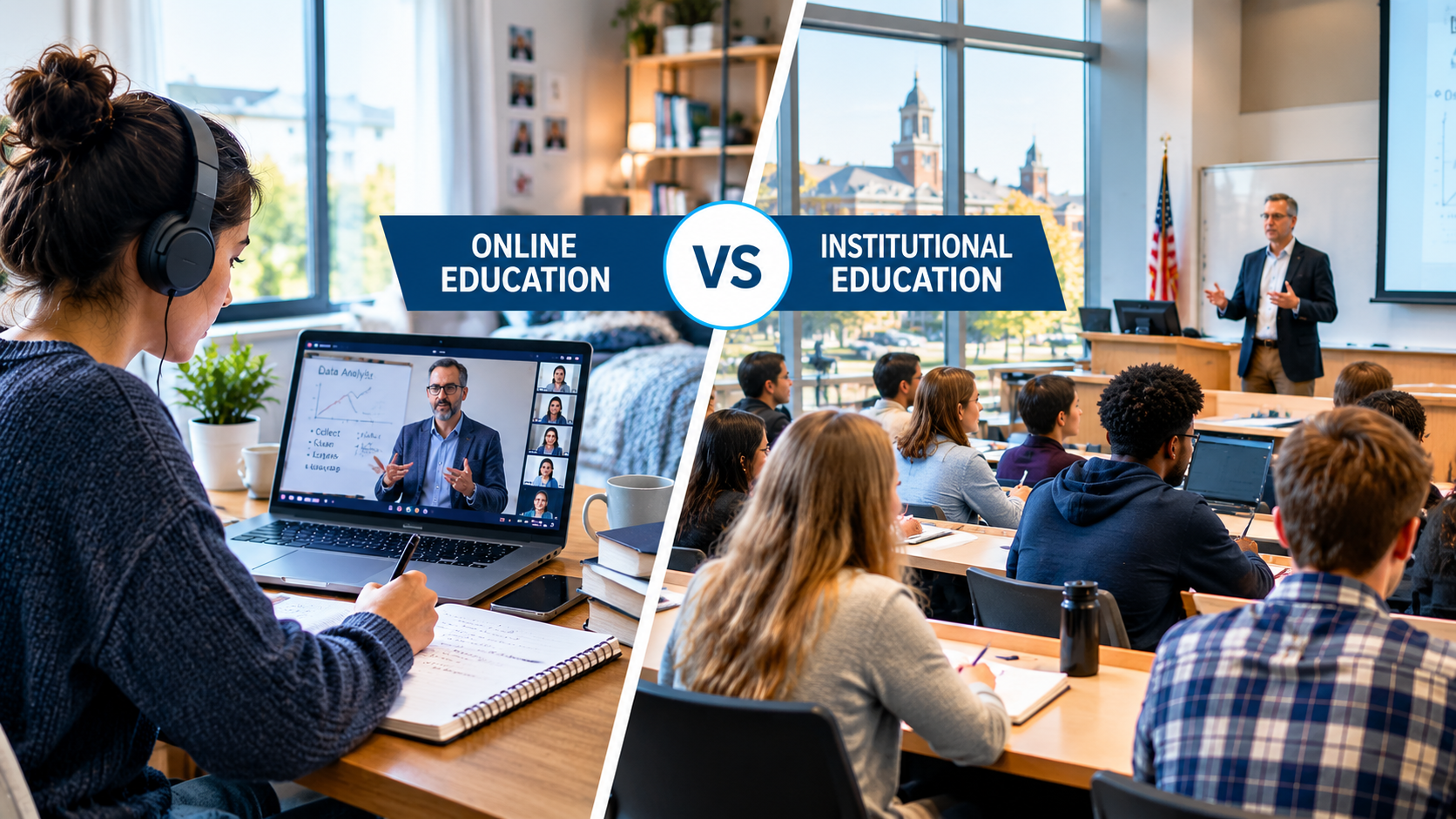
The answer depends on the student’s goals, field of study, financial situation, learning style, career plans, and personal circumstances.
Traditional institutional education offers face-to-face interaction, campus experiences, physical laboratories, direct access to professors, networking opportunities, and a structured academic environment. Online education, meanwhile, provides flexibility, geographic freedom, potentially lower living expenses, and access to programs that may otherwise require relocating.
Neither format is automatically better for everyone.
The most important consideration is not simply whether a degree is online or campus-based. Students should examine the quality of the institution, accreditation, program reputation, curriculum, faculty, career outcomes, total cost, student support, and employer recognition.
This detailed comparison explores the major differences between online education and institutional education in the United States and explains which option may be better for different types of American students in 2026.
What Is Online Education?
Online education refers to academic programs and courses delivered primarily through the internet.
Students may attend lectures through video platforms, complete assignments through learning-management systems, participate in online discussions, take examinations digitally, and communicate with professors through email, video meetings, or messaging platforms.
Online education can include:
- Fully online degree programs
- Hybrid programs
- Online individual courses
- Asynchronous courses
- Live virtual classes
- Online certificate programs
- Professional training
- Graduate and postgraduate programs
- Online community-college programs
Some programs allow students to complete nearly everything remotely, while others require occasional campus visits, internships, clinical training, laboratory work, or examinations.
One of the biggest advantages is geographic flexibility. A student living in Texas, for example, may be able to complete a degree offered by a university in another state without moving there.
What Is Institutional Education?
Institutional education refers to traditional education delivered through a physical educational institution such as a college, university, community college, or specialized school.
Students generally attend classes at scheduled times and locations. They may live on campus, rent accommodation nearby, or commute from home.
Traditional institutional education typically provides:
- Physical classrooms
- Face-to-face lectures
- Campus facilities
- Libraries
- Laboratories
- Student organizations
- Sports facilities
- Career centers
- In-person academic advising
- Direct interaction with professors
- Campus networking
This model has historically been the standard form of American higher education and remains particularly important for students who value campus life and direct personal interaction.
Online Education vs. Institutional Education: Quick Comparison
| Factor | Online Education | Institutional Education |
|---|---|---|
| Flexibility | Very high | Moderate |
| Location | Can often study remotely | Usually requires campus attendance |
| Schedule | Often flexible | Usually fixed |
| Campus experience | Limited or virtual | Extensive |
| Face-to-face interaction | Limited | High |
| Networking | Primarily digital | In-person and digital |
| Living expenses | Potentially lower | Often higher |
| Commuting | Usually unnecessary | May be required |
| Laboratory learning | Limited for some subjects | Stronger |
| Practical training | Depends on program | Generally easier to provide |
| Working while studying | Often easier | Can be more difficult |
| Self-discipline required | High | Moderate |
| Program availability | Broad geographic access | Limited by location |
| Social experience | Primarily virtual | Strong campus community |
| Best suited for | Flexible learners and working adults | Students seeking traditional college experience |
Cost of Online Education vs. Institutional Education
Cost is one of the biggest factors influencing American students when choosing an educational format.
However, comparing only tuition can be misleading.
A student should consider the total cost of attendance, including tuition, fees, housing, food, transportation, textbooks, technology, and other expenses.
NCES data shows that the cost of attending a traditional U.S. college can be substantial. For 2023–24, the average total cost for students attending public four-year institutions while living on campus was approximately $28,349, while the corresponding figure for private nonprofit four-year institutions was approximately $60,924.
Online students may avoid some of these additional expenses.
Tuition Costs
Online education is not automatically cheaper.
Some universities charge similar tuition for online and on-campus programs. Others offer lower-cost online programs, particularly at public universities and community colleges.
The important distinction is that online students may be able to eliminate or reduce other expenses.
Housing Costs
Housing can represent one of the largest expenses associated with attending a traditional college.
Students who attend online can potentially continue living at home rather than paying for:
- Dormitories
- Apartment rent
- Meal plans
- Utilities
- Campus housing fees
This can significantly reduce the overall financial burden.
Transportation Costs
Traditional students may need to commute to campus every day.
Transportation expenses can include:
- Fuel
- Public transportation
- Parking
- Vehicle maintenance
- Insurance
- Time spent commuting
Online students can often eliminate much of this expense.
Technology Costs
Online education does require reliable technology.
Students may need:
- A computer
- High-speed internet
- Webcam
- Headset
- Productivity software
- Specialized academic software
These costs are generally much smaller than many traditional living expenses, but they should still be considered.
Flexibility: One of the Biggest Advantages of Online Education
Flexibility is arguably the strongest advantage of online education.
Traditional education generally follows a fixed schedule. Students may need to attend classes at specific times several days a week.
Online programs can provide significantly more freedom.
Students may be able to study:
- Early in the morning
- During lunch breaks
- In the evening
- On weekends
- Between work shifts
- From home
- While traveling
This makes online education particularly attractive to working adults.
Online Education for Working Adults
Many Americans cannot simply stop working to attend college.
They may have:
- Full-time jobs
- Families
- Children
- Mortgage payments
- Business responsibilities
- Professional commitments
Online education can allow these students to continue working while earning a degree.
A working professional could potentially complete coursework after work or during weekends without relocating or leaving their job.
Traditional education can also accommodate working students, particularly through evening and part-time programs, but online education generally provides greater scheduling flexibility.
Institutional Education Provides More Structure
Flexibility can also become a disadvantage.
Online students must manage their own schedules.
There may be no physical classroom reminding students that they have a lecture at 10 a.m.
This means online students need strong:
- Time-management skills
- Self-discipline
- Organization
- Motivation
- Digital communication skills
Traditional education provides more external structure.
Students have scheduled classes, physical locations, professors, classmates, and academic routines that can make it easier to stay on track.
Quality of Education
A common misconception is that online education is automatically lower quality than traditional education.
That is not necessarily true.
The quality of education depends heavily on the institution and program rather than simply the delivery format.
A well-designed online degree from an established, accredited university can provide a high-quality academic experience.
Likewise, attending a physical campus does not automatically guarantee a high-quality education.
Students should evaluate:
- Accreditation
- Faculty qualifications
- Curriculum
- Graduation rates
- Student support
- Career services
- Employer reputation
- Program-specific accreditation
- Internship opportunities
- Alumni outcomes
Accreditation Matters in the United States
Accreditation is particularly important when choosing an online program.
The U.S. Department of Education does not directly accredit colleges or universities. Instead, it recognizes accrediting agencies and oversees the federal accreditation system.
Students should verify accreditation before enrolling, particularly if they plan to:
- Transfer credits
- Apply for financial aid
- Attend graduate school
- Pursue professional licensure
- Work in regulated professions
Interaction With Professors
Traditional institutional education generally provides more direct face-to-face interaction.
Students can ask questions immediately after class, visit professors during office hours, and participate in classroom discussions.
Online education offers different forms of interaction.
Students may communicate through:
- Video conferences
- Discussion boards
- Online office hours
- Messaging systems
- Virtual group projects
Modern online programs can provide substantial interaction, but the experience is different from being physically present in a classroom.
Student-to-Student Interaction
Traditional campuses have a major advantage when it comes to spontaneous social interaction.
Students naturally meet classmates in:
- Classrooms
- Libraries
- Cafeterias
- Dormitories
- Clubs
- Sports teams
- Campus events
- Student organizations
Online students can still build relationships, but interaction generally requires more intentional effort.
Virtual communities, group assignments, online student organizations, and video meetings can create meaningful connections, but they do not completely replicate the traditional campus environment.
Networking Opportunities
Networking is extremely important in American higher education.
A student’s professional network can influence internships, job opportunities, mentorships, partnerships, and future career development.
Traditional universities can provide extensive opportunities for networking through:
- Alumni events
- Career fairs
- Internships
- Professors
- Student organizations
- Industry events
- Campus recruiting
Online programs can also provide strong networking opportunities, especially when students interact with professionals from different cities and industries.
However, online students may need to be more proactive about building those relationships.
Campus Life
This is an area where traditional institutional education has a clear advantage.
For many students, college is not only about academics.
It is also about experiencing:
- Independence
- Friendships
- Clubs
- Sports
- Cultural activities
- Student government
- Campus events
- Social activities
Students attending online programs generally miss much of this physical campus experience.
Therefore, students who view college as an important social and personal-development experience may prefer traditional education.
Practical and Laboratory-Based Learning
The best educational format often depends on the field of study.
Some subjects work extremely well online.
Examples include:
- Business
- Marketing
- Accounting
- Communications
- Information technology
- Computer science
- Some areas of psychology
- Project management
- Many liberal arts programs
Other fields require significant hands-on training.
Examples include:
- Nursing
- Medicine
- Dentistry
- Engineering laboratory work
- Physical therapy
- Certain sciences
- Skilled trades
- Some healthcare professions
Online programs can incorporate clinical placements, laboratory requirements, internships, and local practical experiences, but students should carefully examine the requirements before enrolling.
Online Education and Technology
Technology is at the center of online education.
Modern students may use:
- Learning-management systems
- Video conferencing
- Digital textbooks
- Cloud-based applications
- Online testing
- Virtual laboratories
- Artificial intelligence tools
- Interactive simulations
This can create a highly flexible learning environment.
Technology can also make education more accessible to students who cannot easily attend a physical campus.
The Role of Artificial Intelligence in Education
Artificial intelligence is becoming increasingly important in American education.
AI tools can assist students with:
- Brainstorming
- Research
- Writing support
- Coding
- Personalized learning
- Practice questions
- Language assistance
- Study planning
However, students must understand their school’s academic-integrity policies.
Using AI to support learning is different from submitting AI-generated work as one’s own when an institution prohibits it.
Universities are increasingly developing policies around responsible AI use, making digital literacy an important part of modern education.
Career Preparation
A major question for students is whether employers value online degrees.
In the United States, the answer increasingly depends on the institution and the student’s qualifications rather than simply whether the degree was completed online.
Employers often consider:
- Institution reputation
- Accreditation
- Degree field
- Work experience
- Skills
- Internships
- Certifications
- Portfolio
- Communication abilities
- Professional experience
An online degree from a respected accredited university can be a legitimate pathway to professional employment.
However, students should avoid assuming that every online institution carries the same reputation.
Online Degrees and Employer Perception
Employer perception has evolved considerably as online education has become more common.
Millions of American students now participate in distance education. NCES data shows that more than half of U.S. postsecondary students took at least one distance-education course in fall 2024.
This widespread adoption has made online learning much less unusual than it was in the past.
Nevertheless, the reputation of the university, quality of the program, accreditation, and student’s demonstrated skills remain important.
Which Is Better for Traditional College Students?
Institutional education may be better for students who:
- Recently graduated from high school
- Want the full college experience
- Prefer structured schedules
- Enjoy face-to-face learning
- Want extensive campus activities
- Need frequent direct interaction with professors
- Want traditional residential college life
For these students, the physical campus can provide valuable academic and social experiences.
Which Is Better for Working Adults?
Online education is often particularly attractive to working professionals.
It allows students to pursue education without necessarily leaving their current employment.
For example, a full-time employee might pursue:
- A bachelor’s degree
- MBA
- Master’s degree
- Certificate
- Professional qualification
while continuing to work.
This can make online education an effective option for career advancement.
Which Is Better for Parents?
Parents may also benefit significantly from online education.
Traditional education may require commuting and attending classes according to a fixed schedule.
Online learning can allow parents to study around family responsibilities.
However, online learning still requires dedicated study time.
Students should not assume that flexibility means the program will be easy.
Which Is Better for Students With Strong Self-Discipline?
Online education is particularly suitable for highly independent learners.
If you can create a schedule, meet deadlines without constant supervision, and study independently, online education can work extremely well.
Students who struggle with procrastination may benefit more from the structure of traditional education.
Which Is Better for Networking?
Traditional education generally has an advantage because students spend more time physically around professors, classmates, alumni, employers, and other professionals.
However, online students can compensate through deliberate networking.
They can use:
- Virtual career fairs
- Online alumni groups
- Professional organizations
- Industry conferences
- Remote internships
- Online student communities
The quality of networking depends heavily on how actively the student participates.
Which Is Better for Saving Money?
There is no universal answer.
An online program may be cheaper overall because students can avoid:
- Campus housing
- Meal plans
- Transportation
- Relocation
- Parking
- Some campus fees
But some online universities charge tuition comparable to their traditional programs.
Students should compare total cost, not simply advertised tuition.
Online Education vs. Institutional Education for Graduate Students
Graduate students often have different needs than undergraduate students.
Many graduate students are already working professionals.
For them, online education can be particularly attractive.
An online MBA, master’s degree, or professional program may allow a student to continue working while studying.
Traditional graduate programs may still be preferable for students pursuing research-intensive careers, laboratory sciences, clinical fields, or programs where face-to-face faculty interaction is essential.
Online Education vs. Institutional Education for Community College Students
Community colleges are an important part of American higher education.
Students can often use community colleges to complete lower-level coursework before transferring to a four-year institution.
Many community colleges offer both online and traditional classes.
For students focused primarily on affordability and academic progress rather than campus life, online community-college courses can be an attractive option.
The Importance of Program-Specific Requirements
Students should never choose online education solely because it appears convenient.
Before enrolling, check whether the program requires:
- In-person laboratories
- Clinical rotations
- Internships
- Student teaching
- Campus examinations
- Residency requirements
- Professional licensing requirements
Some careers have strict educational and practical requirements.
A program that looks completely online may still require physical attendance for specific components.
Accessibility and Geographic Freedom
Online education provides a major advantage for students who cannot easily relocate.
A student in a rural area may gain access to programs offered by institutions hundreds or thousands of miles away.
This can expand educational opportunities without requiring relocation.
Traditional education, by comparison, usually limits students to institutions they can reasonably reach or relocate to.
The Disadvantages of Online Education
Online education has many advantages, but it is not perfect.
Potential disadvantages include:
- Isolation
- Reduced face-to-face interaction
- Greater need for self-discipline
- Technology problems
- Screen fatigue
- Fewer spontaneous networking opportunities
- Limited physical facilities
- Reduced campus experience
- Difficulty with hands-on subjects
Some students simply learn better when they are physically present in a classroom.
The Disadvantages of Institutional Education
Traditional education also has disadvantages.
Students may face:
- Higher living expenses
- Commuting
- Fixed schedules
- Relocation costs
- Less flexibility
- Campus housing costs
- Greater time commitments
For working adults, these limitations can make traditional education difficult.
Hybrid Education: The Middle Ground
Students do not always have to choose between completely online and completely traditional education.
Hybrid education combines both.
A student might complete most coursework online while attending campus periodically for:
- Laboratories
- Workshops
- Exams
- Group projects
- Clinical training
- Networking events
Hybrid programs can provide a balance between flexibility and face-to-face interaction.
For some students, this may be the best option of all.
Online Education Is Becoming a Mainstream Part of U.S. Higher Education
The latest NCES data demonstrates just how significant distance education has become.
In fall 2024, 54.7% of students enrolled in U.S. degree-granting postsecondary institutions took at least one distance-education course, while 26.5% were enrolled exclusively in distance education.
These numbers show that online learning is no longer a niche alternative.
It has become an important component of American higher education.
What Students Should Check Before Choosing an Online Program
Before enrolling, students should research the institution carefully.
Check Accreditation
Verify that the institution is appropriately accredited by a recognized accrediting organization.
The U.S. Department of Education provides resources for researching recognized accreditation and accredited postsecondary institutions.
Compare Total Costs
Look beyond tuition.
Calculate:
- Tuition
- Fees
- Books
- Technology
- Housing
- Transportation
- Food
- Other academic expenses
Research Graduation and Completion Outcomes
Look for information about student outcomes.
A low advertised tuition price may not be attractive if students have difficulty completing the program.
Examine Career Services
Strong career support can be valuable for students entering competitive industries.
Look for:
- Career counseling
- Internship support
- Resume assistance
- Employer connections
- Career fairs
- Alumni networking
Research the Curriculum
Make sure the courses teach relevant skills.
Compare the curriculum with job descriptions in the field you want to enter.
Is Online Education Better Than Institutional Education in 2026?
There is no single answer.
Online education may be better for a working professional who needs flexibility.
Traditional education may be better for an 18-year-old student who wants the complete campus experience.
A hybrid program may be better for someone who wants both flexibility and occasional in-person instruction.
The best option depends on the individual.
Final Verdict: Online vs. Institutional Education
Online education and institutional education are no longer simply competing models.
They are two different ways of achieving educational goals.
Online education is generally stronger in:
- Flexibility
- Geographic freedom
- Convenience
- Working-student compatibility
- Reduced commuting
- Potentially lower living expenses
- Access to programs outside a student’s local area
Institutional education is generally stronger in:
- Campus experience
- Face-to-face interaction
- Social development
- Physical networking
- Laboratory learning
- Structured schedules
- Traditional college experience
For American students in 2026, the smartest approach is to focus less on the label “online” or “traditional” and more on the quality and value of the specific program.
An accredited online degree from a respected university can be an excellent investment, particularly for working adults and students who need flexibility. At the same time, a traditional university can provide experiences that are difficult to reproduce digitally, particularly for students who value campus life, personal interaction, laboratories, and in-person networking.
Ultimately, the best education format is the one that matches the student’s career goals, learning style, financial situation, schedule, and personal circumstances.
The growth of distance education in the United States shows that online learning has firmly established itself within American higher education. With more than 10.7 million students taking at least one distance-education course in fall 2024, online education is clearly not a temporary trend.
For students making a decision in 2026, the real question is therefore not simply “Online or traditional?”
It is:
“Which accredited program gives me the best combination of education quality, career preparation, affordability, flexibility, and long-term value?”
That is the question that should guide the final decision.

Seraphina Vale is a passionate content writer and blogger with 3 years of blogging experience, specializing in creating engaging, well-researched, and reader-focused articles. She enjoys breaking down complex topics into clear, practical insights that help readers stay informed and make confident decisions.